



Nearly eight months after the African Descent Society British Columbia (ADS) was ordered to pay more than $10,000 to a Vancouver business, a Provincial Court record states plainly: “No payment made.”
ADS is the non-profit behind Vancouver’s African Descent Festival and has received more than $2 million in public funding since 2016. Coastal Front has previously reported on unpaid vendors, festival permit problems, and the repeated overlap between the society’s operations and executive director Yasin Kiraga Misago’s private business interests.
If you’re new to this story, it’s worth reading Coastal Front’s January investigation before continuing. It lays out the background behind the funding, vendor disputes, and private-business overlap in full.

The court record at the centre of this latest chapter stems from one of those vendor disputes. On January 2, ADS was ordered to pay Right Way Traffic Systems $10,651.80 by June 1 after the company sued over money it said was owed for work connected to the 2024 festival.
That deadline came and went.
By August, the judgment remained unpaid and the dispute was back before the court. Records show that a summons had been served for a payment hearing, a proceeding where the court assesses a debtor’s ability to pay and whether a payment schedule should be ordered, but no one appeared for ADS. The judge then ordered the society to disclose its finances, including its most recent grant income, and issued a warrant of arrest for executive director Yasin Kiraga Misago in connection with the missed hearing.
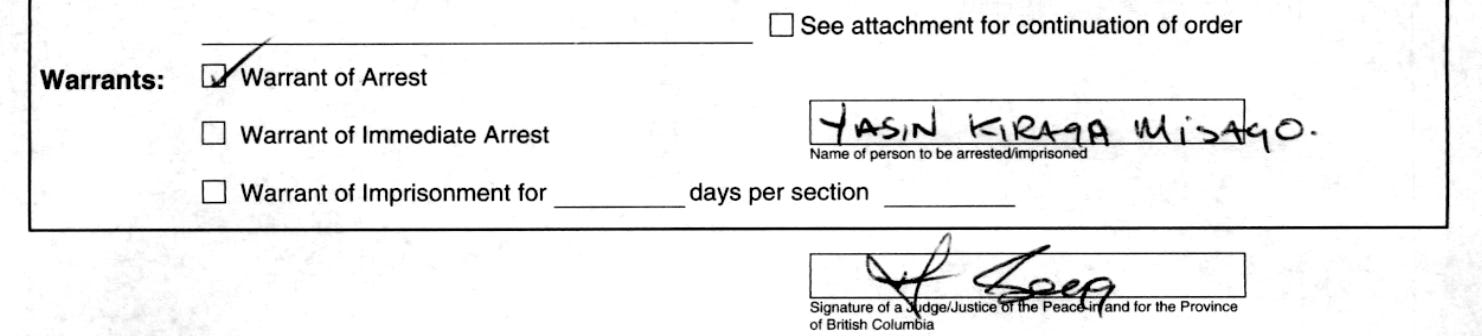
Two days after that August 27 court order, a federal contribution agreement with ADS was scheduled to end. By then, unpaid bills, court disputes and permitting problems had dogged the society over the previous year, yet Ottawa continued approving funding for the organization.
The warrant was later cancelled on the condition that Misago appear in person in court on November 24.
Unanswered questions
The latest taxpayer-funded agreement was worth $26,600 for the “African Descent Festival 2026” through Canadian Heritage’s Building Communities Through Arts and Heritage program. Federal records list the agreement dates as May 10 to August 29.
Coastal Front asked Canadian Heritage a straightforward question: exactly how much of the $26,600 contribution had actually been disbursed to the African Descent Society?
Canadian Heritage media representative David Larose responded:
“The African Descent Society British Columbia has been approved for a contribution of $26,600 through the Building Communities Through Arts and Heritage program.”
That was not the question.
The $26,600 approval was already publicly available in the federal grants database. Coastal Front had specifically asked how much money had actually been paid.
Coastal Front replied to Larose asking him to re-read the inquiry and clarify the amount disbursed. As of publication, Canadian Heritage had not answered that question.
An important distinction is that the federal record classifies the funding as a contribution rather than a grant. Treasury Board rules say contributions are used when departments need to monitor progress and results, require an accounting of how public money is used, and retain the right to audit the recipient or obtain other audit assurance. The same rules say monitoring should reflect, among other things, the recipient’s risk profile. By then, it would have taken a remarkably generous assessment of the available facts to find little cause for concern.
More than $2 million later
For anyone who has followed the African Descent Society, the latest federal approval should sound familiar.
As previously reported by Coastal Front, ADS has received more than $2 million in public funding from federal, provincial and municipal governments since 2016. Federal records accounted for roughly $1.3 million, the BC government had provided at least $720,000 since 2018, and the City of Vancouver had confirmed $101,000 in Arts and Culture Grants.


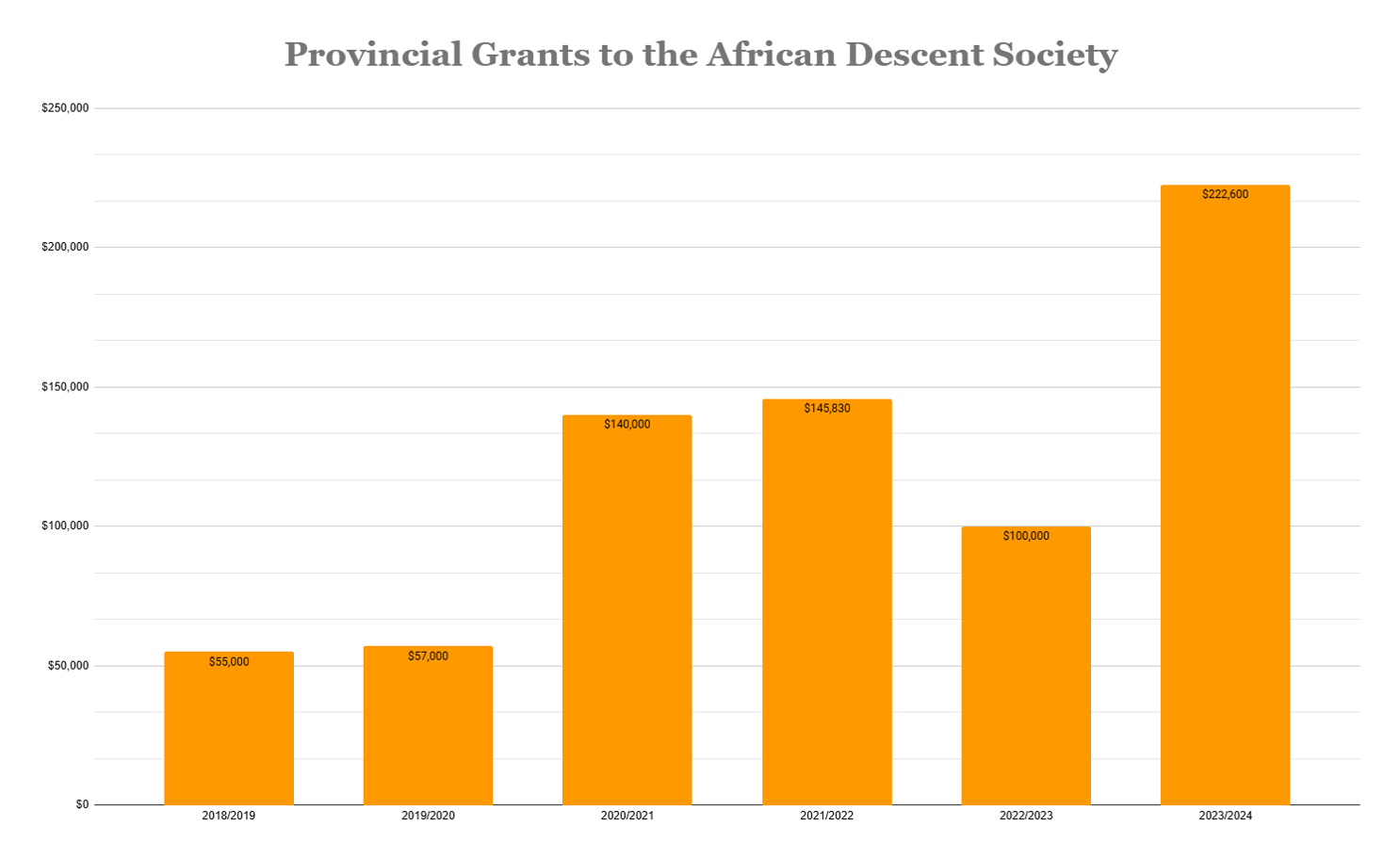
Our January report found potential conflicts of interest involving Misago’s private companies, Frontline Public Relations and Frontline Records Vancouver.
Both companies shared office space with ADS. At least eight artists represented by Frontline had also performed at ADS events dating back to 2016.
There was also the studio.
ADS’s 2023 annual report said the society established a music production studio under Misago’s leadership. A 2022 post from the society called its newly created facility “Frontline Records Studio,” the same name as Misago’s private music company. Photos appearing to show the same studio were published on Frontline Records’ website.
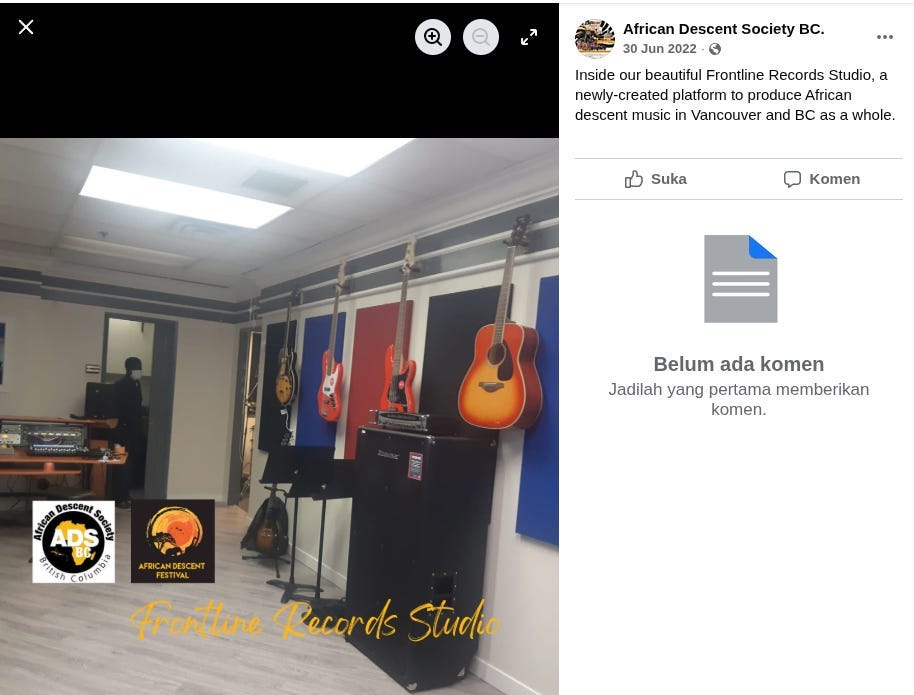
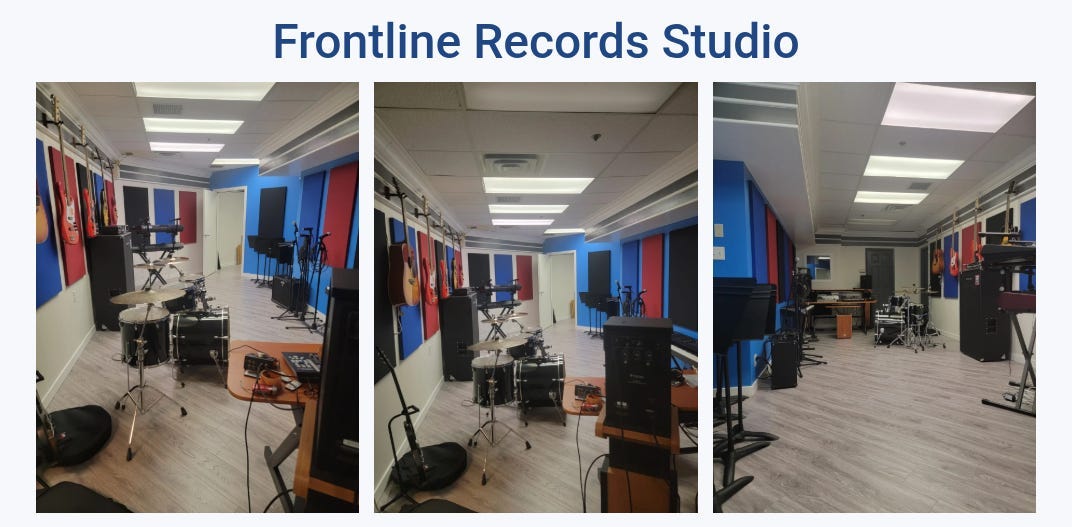
City of Vancouver records indicated more than $32,000 had been directed to ADS for the studio in 2022 and 2023.
The concern is that public money was provided to ADS for a society music studio, yet the facility was publicly branded as “Frontline Records Studio,” the name of a private company controlled by ADS’s executive director.
It raised the question of where a publicly funded non-profit ended and the executive director’s private businesses began.
When Coastal Front first asked Misago about the potential conflict, he responded: “Is providing a service a conflict of interest?”
Meanwhile, other businesses that provided services to ADS were having trouble getting paid.
RWTS also described what it viewed as a broader pattern in how ADS dealt with Black-owned vendors. The company said Misago invoked shared community ties, referring to its representatives as “brothers” and saying he expected support from Black-owned businesses. According to RWTS, Misago later asked during court proceedings, “Why should we fight in court as brothers?”
RWTS characterized those appeals as exploitative, saying Black-owned businesses were encouraged to participate in the name of shared cultural goals only to later be left unpaid.
Cornerstone Security and Transport Inc. also said it was owed more than $16,000 after providing security for the 2024 African Descent Festival.
In August 2025, the Vancouver Park Board refused to permit that year’s festival at English Bay, saying organizers had not resolved outstanding issues from previous events in time to meet planning, safety and operational requirements. Staff said organizers were offered alternatives, including relocation to Thornton Park or postponement.
Yet the government-funded gravy train kept rolling. Even as unpaid bills and other problems mounted through 2024 and 2025, ADS continued to secure public funding.
By January 2, 2026, ADS had been ordered to pay Right Way Traffic Systems $10,651.80 by June 1.
Four months later, federal records list the new $26,600 festival contribution agreement.
What did Ottawa know?
This is where the story becomes less about ADS’s conduct and more about why governments kept approving public money despite a growing record of unpaid vendors, court disputes, and questions about the society’s governance.
For festivals beginning between July 1 and August 31, applications to the Local Festivals program are due October 15 of the previous year, with the online portal opening approximately six weeks beforehand. By the time the 2026 application window opened, the previous African Descent Festival had already been shut out of English Bay and the Park Board’s explanation was public. RWTS had also filed its Small Claims action against ADS in August. Coastal Front had also already published reporting on ADS’s public funding and potential conflicts involving Misago’s private interests.
By the time the application window opened, those concerns were already publicly documented. A basic internet search of the society would have surfaced the Park Board dispute and published reporting about ADS’s finances and governance. A review of court records would also have revealed the proceedings involving the society.
More importantly, Canadian Heritage’s application guidelines explicitly say its evaluation process could include a review of internet content, media articles about the festival or organization, and other public documents. The department also says failures to meet conditions of previously funded projects are considered in new applications and can result in rejection.
Did anyone look?
Canadian Heritage’s financial requirements raise further questions.
Incorporated applicants must provide their incorporation documents, bylaws, two most recent financial statements — audited if available — and a list of directors. A complete application must also include brochures, programs, plans and promotional material from the previous edition of the festival, while previously funded applicants must submit a completed final report for their previously completed festival. Because the 2025 African Descent Festival was cancelled, the most recent completed edition was the 2024 festival.
Heritage says evaluators consider an organization’s ability to deliver its festival on a reasonable and balanced budget, the results of previous editions, and its contingency plan for problems including a budget deficit.
That gives rise to some fairly basic due-diligence questions.
What did ADS’s financial statements show? Were outstanding debts reflected? Did Canadian Heritage know that businesses were pursuing the society for payment? Did it know that, by January, a court had ordered ADS to pay RWTS? And if officials were aware, what effect did any of it have on their assessment?
Also, Canadian Heritage’s published guidelines included a requirement that an applicant’s most recently completed festival be “organized and successfully delivered within the last two years.”
With the 2025 edition cancelled, that appears to leave the 2024 festival as the most recently completed edition. It was also the festival after which RWTS and Cornerstone say substantial bills remained unpaid, raising the question of what Heritage considered a “successfully delivered” festival.
Then there is municipal support.
Canadian Heritage required evidence that a municipality or equivalent public authority was supporting the festival, and federal funding was conditional on that support being confirmed.
Despite the Park Board’s refusal to permit the 2025 festival amid unresolved issues from previous events, the City of Vancouver told Coastal Front it provided the required confirmation of support for ADS’s 2026 Canadian Heritage application.
Court enforcement escalated
The court case, meanwhile, did not disappear. By June, RWTS was back in Provincial Court pursuing payment of the outstanding judgment. Court records show that a summons for a payment hearing was served on June 15.
Then came August 27.
“No payment made.”
“Def. did not appear.”
The judge ordered financial statements specifically including ADS’s most recent grant income, and a warrant of arrest naming Misago was temporarily issued.
At nearly the same time, ADS still had an active federal contribution agreement.
And there is another wrinkle.
The African Descent Festival’s website now advertises the 2026 festival for October 9 to 11 at the Pinnacle Hotel at 133 West Hastings Street, after postponing its original August dates. ADS says the Vancouver Park Board and Vancouver Police Department requested that organizers reschedule to a later date or temporarily relocate to allow additional time to coordinate the event. That is ADS’s account.
Canadian Heritage’s public record still lists the contribution agreement ending August 29.
So the questions continue: was the agreement amended or extended after the postponement? Was any money already disbursed? If so, how much? Were further payments withheld? Will any money be recovered?
Canadian Heritage has yet to answer question number one.
Safeguards existed
This is not a government program without accountability tools. It is a government that chooses to not use them.
Canadian Heritage reserves the right to audit recipients’ accounts and records for compliance with funding agreements. Recipients must retain records that may be required for an audit or evaluation for five years, and the department warns that failing to maintain them may result in repayment of money previously received.
Treasury Board rules go further. Federal departments are expected to take a risk-based approach throughout the management of transfer payments, including funding agreements, cash management, reporting, recipient monitoring and auditing. The level of monitoring must reflect, among other things, the risk profile of the recipient. Departments can also retain a portion of a payment where appropriate because of the risk of non-performance or overpayment.
Those provisions do not mean Canadian Heritage had to reject ADS. They do show, however, that the government had tools to scrutinize the organization before and after approving public funding.
Canadian Heritage now needs to explain how much of the $26,600 was actually disbursed; what internet, media and public-record review was conducted; what ADS’s financial statements showed; whether officials knew about the RWTS judgment; which previous festival Heritage relied on to satisfy its prior-edition eligibility requirements; and whether the escalating court proceedings, postponed festival dates or move beyond the listed agreement period prompted any reassessment.
These are not arguments against public funding for African cultural events. The African Descent Festival can provide genuine cultural value and community benefit.
Coastal Front reached out to Misago for comment. He responded by accusing Coastal Front of “terrorising” ADS with “false news.”
“WE ARE PARENTS AND PROFESSIONALS, WHY ARE YOU WRITING STUPID THINGS YOU HAVE NO EVIDENCE?” he said.
The issue remains what it was when Coastal Front first examined ADS: why governments keep approving public money for a society whose operations repeatedly overlap with Misago’s private business interests, while vendors go unpaid and court enforcement escalates, and what due diligence is being done before more funding is approved.
Canadians are expected to trust that public money is scrutinized before it is approved. In this case, Canadian Heritage has done nothing to show what that scrutiny actually looked like, providing no substantive answer to Coastal Front’s inquiry.
Coastal Front has filed an access-to-information request seeking records related to the 2026 contribution, and will continue reporting as those records become available.
Well written. Complex story explained plainly. Government needs to be more accountable in handling taxpayer funds, regardless of who it goes to.