


Canadians with investments are pulling further ahead while those struggling to afford groceries, fuel, and housing are increasingly pessimistic about their future, according to new polling that points to a widening divide in household financial security.
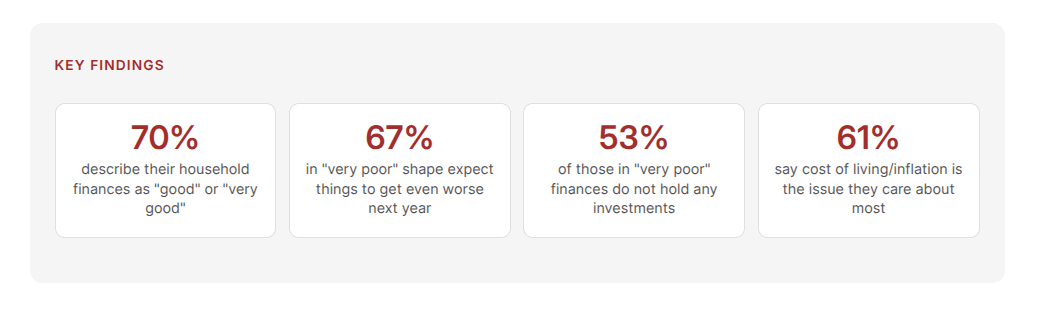
A new Angus Reid Institute survey found seven in 10 Canadians describe their household finances as good or very good, while more than one-quarter say they are in poor or very poor shape.
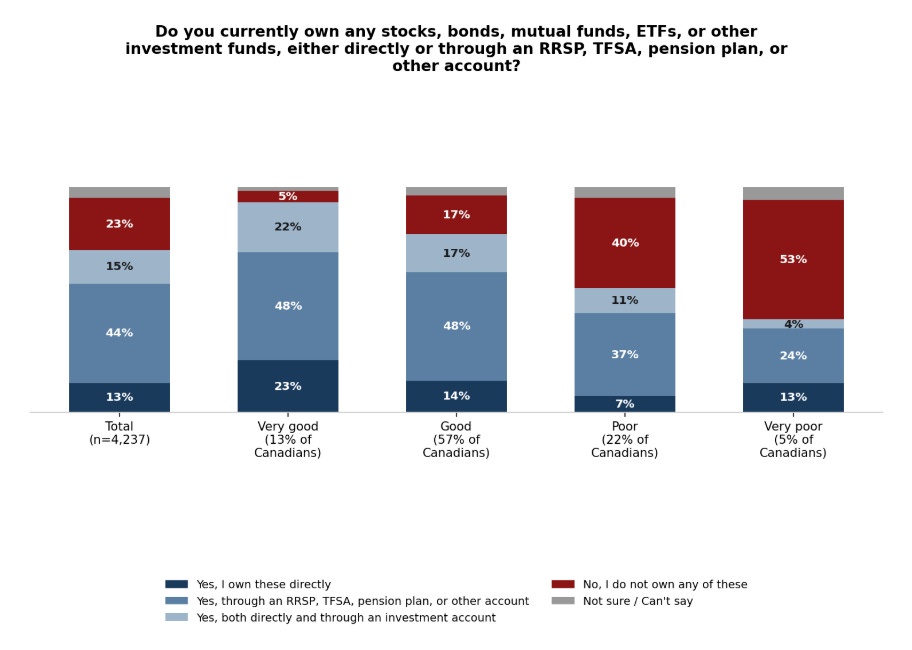
The gap is especially clear when it comes to investments. Nearly all Canadians who consider themselves in very good financial shape hold some form of investment, while more than half of those in very poor financial circumstances do not.
As investment values have climbed, many households with assets have been better positioned to absorb years of higher prices. Angus Reid noted that $100 invested in the TSX in early 2020 would be worth roughly $261 by the second quarter of 2026, compared with about $122 needed to keep pace with inflation over the same period.
For those without investments, the picture is much bleaker.
Canadians who describe their finances as poor are three times as likely to say they expect to be worse off a year from now as they are to expect improvement. Among those in very poor financial circumstances, two-thirds expect further decline.
Cost of living remains the country’s dominant concern, chosen by 61 percent of Canadians as the issue they care about most. The concern grows more acute among those already under financial strain.
The pressure is changing household behaviour. More than half of Canadians say they are cutting back on dining out, takeout or coffee shops, while others report reducing spending on entertainment, travel and savings. More than one-third say they are trying to spend less on food at home.
For households in poor or very poor financial condition, groceries, housing payments, fuel and the inability to save rank among the most significant sources of stress.
The survey arrives as federal leaders continue to point to easing inflation and improving labour market conditions as signs of economic resilience. Yet the findings suggest many Canadians remain unconvinced that those gains are reaching them.
While headline economic indicators have stabilized, the poll points to a growing divide between Canadians building wealth through investments and those still struggling to keep up with everyday costs — a gap that appears to be shaping both economic confidence and political sentiment.
I feel this.
This really shows how differently people can experience the same economy. Markets may be performing well and inflation may be stabilizing, but those improvements mean much less when everyday costs still prevent many Canadians from building savings or investing in the first place.