


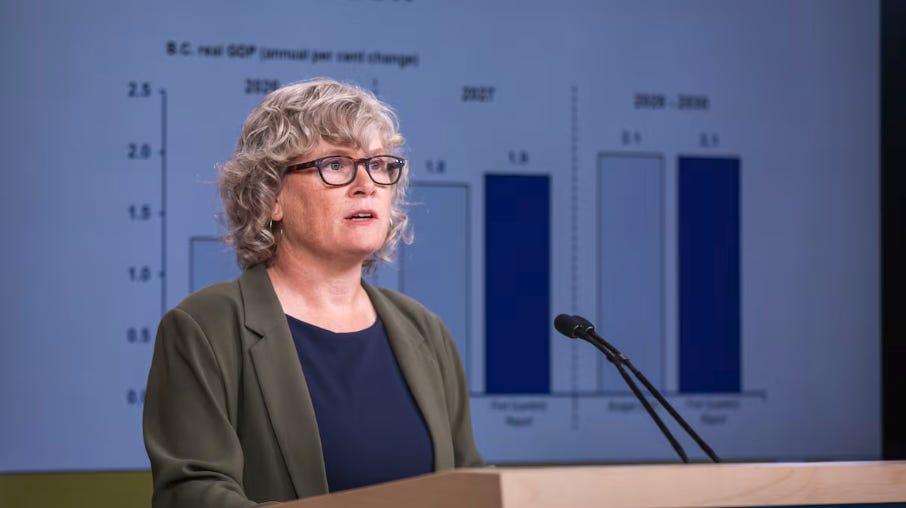
British Columbia’s projected deficit has climbed to $13.8 billion, with forecast expenses rising $1.2 billion from Budget 2026, as the Business Council of British Columbia (BCBC) warns the province’s fiscal position continues to deteriorate.
The province’s first quarterly report for 2026-27 puts the deficit $450 million higher than projected in February’s budget. Revenue is now forecast at $86.3 billion, $789 million above the budget forecast.
BCBC says the latest numbers continue a “troublesome pattern” of fiscal deterioration over the past five years.
Since 2021-22, provincial revenues have increased by about four percent annually while operating spending has grown at eight percent a year, according to BCBC. The council says operating expenses will surpass $100 billion in 2026-27, one year earlier than projected in February’s budget.
The province says the increase in forecast expenses is mainly due to wildfire costs and refundable tax credits.
Fire-management expenses are forecast to be $614 million above budget, while refundable tax credits are projected to cost an additional $458 million.
Finance Minister Josie Osborne has also pointed to U.S. tariffs, the conflict in the Middle East and tighter federal immigration policy as economic pressures facing the province.
The government has highlighted increases in exports, manufacturing shipments and international travellers entering BC. Goods exports increased 4.2 percent year to date through July, including a 16-percent increase to non-U.S. destinations. Manufacturing shipments were up 9.1 percent year to date through June, while international travellers entering BC increased 6.6 percent over the same period.
Real GDP growth is now forecast at 0.9 percent in 2026, down from 1.3 percent in Budget 2026. Employment was down 0.6 percent year to date through August, when the unemployment rate stood at 6.5 percent. Housing starts were down 9.3 percent and home sales were down six percent year to date through July.
The higher revenue forecast includes increases of $471 million in personal income-tax revenue, $416 million in corporate income-tax revenue and $169 million in provincial sales-tax revenue.
BCBC says the income-tax gains partly reflect one-time prior-year tax settlements and higher inflation expectations. Those gains are offset in part by weaker revenue elsewhere, including a $531-million reduction in forecast natural-gas royalties and a $305-million decline in property transfer-tax revenue.
BCBC estimates the increase in operating expenses since February amounts to about $200 per British Columbian.
The fiscal update also reflects errors in the province’s natural-gas royalty forecast.
The government has reduced its natural-gas royalty forecast by $531 million. About $306 million of that revision corrects calculation errors in the Budget 2026 price forecast, while the remainder reflects lower expected prices and revised assumptions about the proposed royalty framework.
Osborne has acknowledged the seriousness of the error and said steps are being taken to prevent a recurrence.
Total provincial debt is forecast to reach $180.9 billion by the end of 2026-27, including $141.1 billion in taxpayer-supported debt. The taxpayer-supported debt-to-GDP ratio is forecast at 30.1 percent.
BCBC says total provincial debt has risen from about $90 billion in 2021-22 to roughly $180 billion this year. Debt-servicing costs have increased from $2.7 billion to $6.3 billion over the same period.
Peter Milobar, interim leader of a new breakaway party and MLA for Kamloops Centre, called the quarterly report a “pretty depressing read” and argued that improving the province’s finances will require stronger private-sector growth.
BC Conservative finance critic Gavin Dew said the government has a “spending problem and a math problem.”
Osborne said the government will continue protecting public services while growing and diversifying the economy and investing in jobs.
BCBC says the quarterly report continues a five-year pattern of rising spending, debt and debt-servicing costs, and argues the province has yet to establish a path to stabilize its finances.