


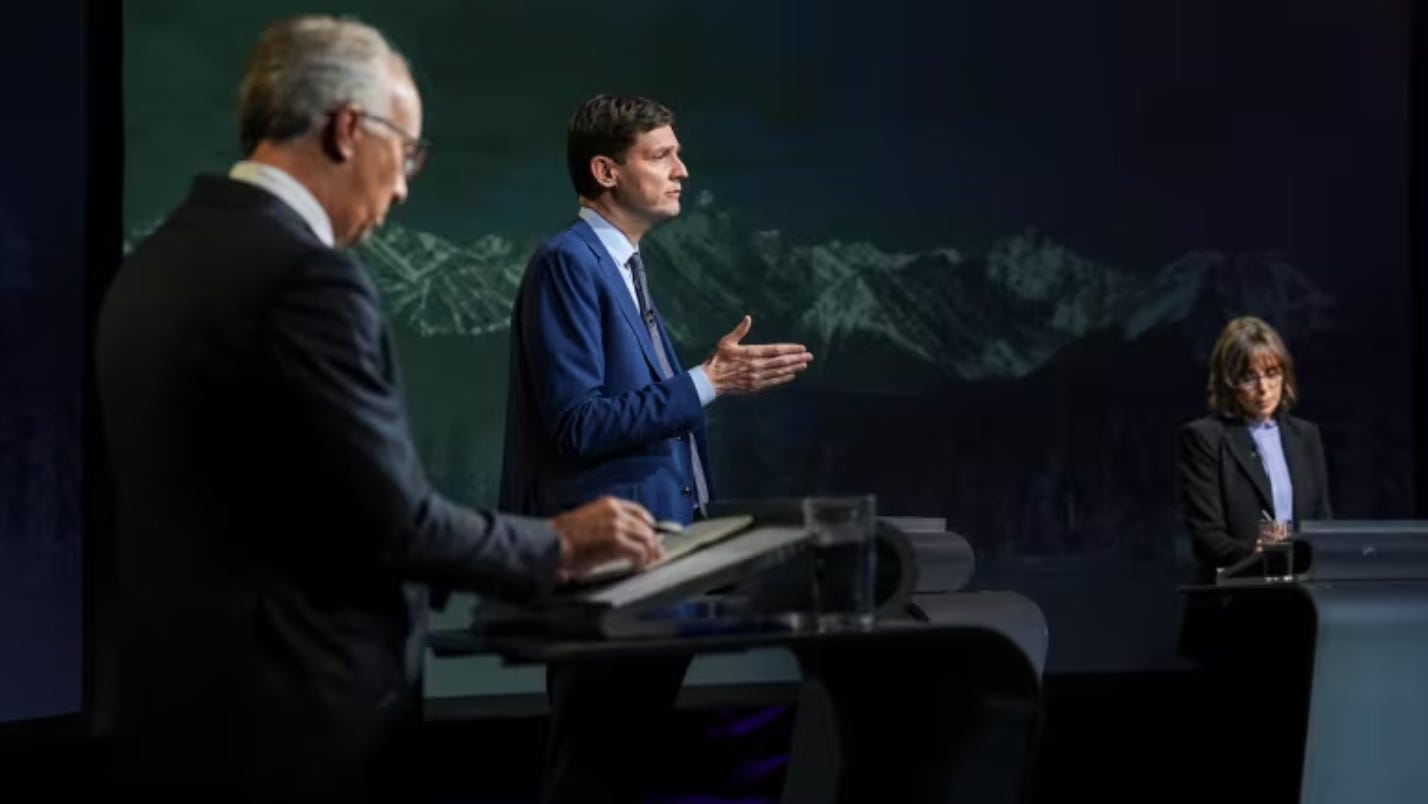
Image courtesy Ben Nelms/CBC
In a heated 90-minute televised debate Tuesday night, British Columbia’s three major party leaders—NDP leader and Premier David Eby, BC Conservative leader John Rustad, and BC Green Party leader Sonia Furstenau—sparred over housing, healthcare, fiscal policy, and more ahead of the provincial election.
All three leaders agreed that housing affordability is a crisis, but their proposed solutions diverged sharply. Rustad criticized the NDP’s housing policies, claiming they “get in the way” of private sector efforts. He proposed reducing red tape and investing in infrastructure upgrades to facilitate new construction, including a $1 billion annual fund to support community-based developments.
Eby countered Rustad’s claims by emphasizing the NDP’s focus on affordable housing. He highlighted the party’s plan to deliver 300,000 middle-income homes over the next decade, partly by expanding the Speculation and Vacancy Tax. This approach, Eby argued, would reduce speculative pressures on the housing market and make homes more accessible to British Columbians.
By introducing the speculation tax, we were able to turn 20,000 houses into homes for families.
There is no single solution to the housing crisis, this is just one way to help people right now. #bcpoli— David Eby (@Dave_Eby) October 9, 2024
Eby has previously defended the province's deficit, underscoring that investing in housing and infrastructure is essential for long-term stability and is not "short-sighted," a sentiment he reiterated during the debate.
Furstenau, taking a different approach, argued that the focus should be on stopping corporate entities like real estate investment trusts from inflating housing costs. She advocated for rent caps and vacancy controls to protect tenants from financialized housing pressures, a stance she claims differentiates the Green Party from both the NDP and Conservatives.
Healthcare and Public Safety
Healthcare was a divisive topic. Eby emphasized his party’s plans to streamline credential recognition for internationally trained healthcare professionals and expand mental health services in schools. Rustad argued for a more radical overhaul, proposing a “Patients First” approach with activity-based funding to replace block grants. This model, according to Rustad, would financially reward hospitals based on the number of patients treated, aiming to improve efficiency.
Additionally, Rustad suggested implementing wait time guarantees for life-threatening conditions. Under this plan, patients exceeding medically recommended wait times could seek care at approved out-of-province facilities, with costs reimbursed under a set fee schedule. He also advocated for increased partnerships with private clinics for specific publicly funded procedures, claiming this would reduce strain on public facilities and improve patient outcomes. Critics warn this could lead to a two-tiered system, potentially drawing resources away from public hospitals. Rustad, however, maintained that his focus is on cutting bureaucratic costs and improving patient care through practical reforms.
The choice in this election is between me and someone who has:
- Caused widespread ER closures
- Broken BC’s budget
- Sexualized schools
- Sold out workers
- Raised Carbon Tax with Trudeau
- Undermined property rights
- Bullied municipalities
- Taxed people into poverty#bcpoli https://t.co/GkdL5lfSs9— John Rustad (@JohnRustad4BC) October 1, 2024
Public safety also played a prominent role. Rustad claimed he saw someone die of an overdose en route to the debate, blaming the alleged death on what he called the NDP’s failed decriminalization policies. He further criticized Eby’s stance on drug policy, alleging that the government’s approach has made drug-related deaths more common. Eby has acknowledged the need to adjust policies on safe supply but stressed that the NDP is committed to adapting when strategies prove ineffective.
The BC Coroners Service says it has no record of any recent drug toxicity death at the Vancouver intersection where Rustad said he saw a man die, the Canadian Press reports.
Nonetheless, toxic drugs claimed BC lives at a rate of approximately six people per day in the first half of 2024, according to data from the Service.
This is what I saw before the debate last night. It occurred near the intersection of Burrard and Davie.
I did not take this photo, it was sent to me. There was an ambulance at the scene when I saw it.
My staff walked by as CPR was happening. One lady said “he's overdosed”.… pic.twitter.com/vBxr7SMET5— John Rustad (@JohnRustad4BC) October 10, 2024
John Rustad offers a plan that plays on people’s fears and frustrations, but it won’t fix anything. All he knows how to do is break things and then complain when they’re broken. https://t.co/AmVY2SkxLM
— Sonia Furstenau (@SoniaFurstenau) October 8, 2024
Fiscal Responsibility
Financial accountability was another major theme. Eby defended the NDP’s recently unveiled $2.9 billion platform, which includes a $1,000 annual tax cut for middle-income families. Acknowledging the province’s $8.9 billion deficit, he argued that the NDP’s strategy of targeted investments is essential for BC’s long-term growth. Eby criticized Rustad for not releasing a fully costed platform, calling it “pixie dust,” while Rustad dismissed this as “political theatrics.”
BC is facing a record $8.9 billion deficit heading into the provincial election, with the total debt projected to exceed $129 billion. The province’s annual interest payments alone have reached $3.5 billion, or $9.6 million per day.
Premier David Eby, in an exclusive interview…— Reid Small (@ReidSmall) September 23, 2024
Furstenau highlighted the Green Party’s commitment to a fully costed fiscal approach. Her platform proposes new taxes on high-income earners and corporations to fund social programs. “We have to tax wealth properly to build a fairer economy,” she said, positioning her party as the only one with a balanced approach to both spending and taxation.
Furstenau’s fiscal plan emphasizes environmental sustainability, with funding directed to clean energy initiatives and critical social infrastructure, a stance aimed at setting her party apart from traditional approaches.
Independent Candidates and the Balance of Power
As the BC NDP and Conservatives continue to poll neck-and-neck, independents may influence the election outcome. Following the collapse of BC United, 40 independent candidates are running, some in traditionally right-leaning districts. Analysts suggest that independents could potentially split the Conservative vote, giving the NDP an advantage in close ridings like Surrey, Richmond, and Parksville-Qualicum.
Recent polling places the NDP slightly ahead at 46 percent, with the Conservatives close behind at 44 percent. The Green Party remains at nine percent, though Furstenau’s performance could influence undecided voters as the election approaches.
Advanced voting begins on October 10.
Who came out on top in the British Columbia leaders’ debate? #bcpoli
— Coastal Front (@CoastalFrontBC) October 9, 2024