


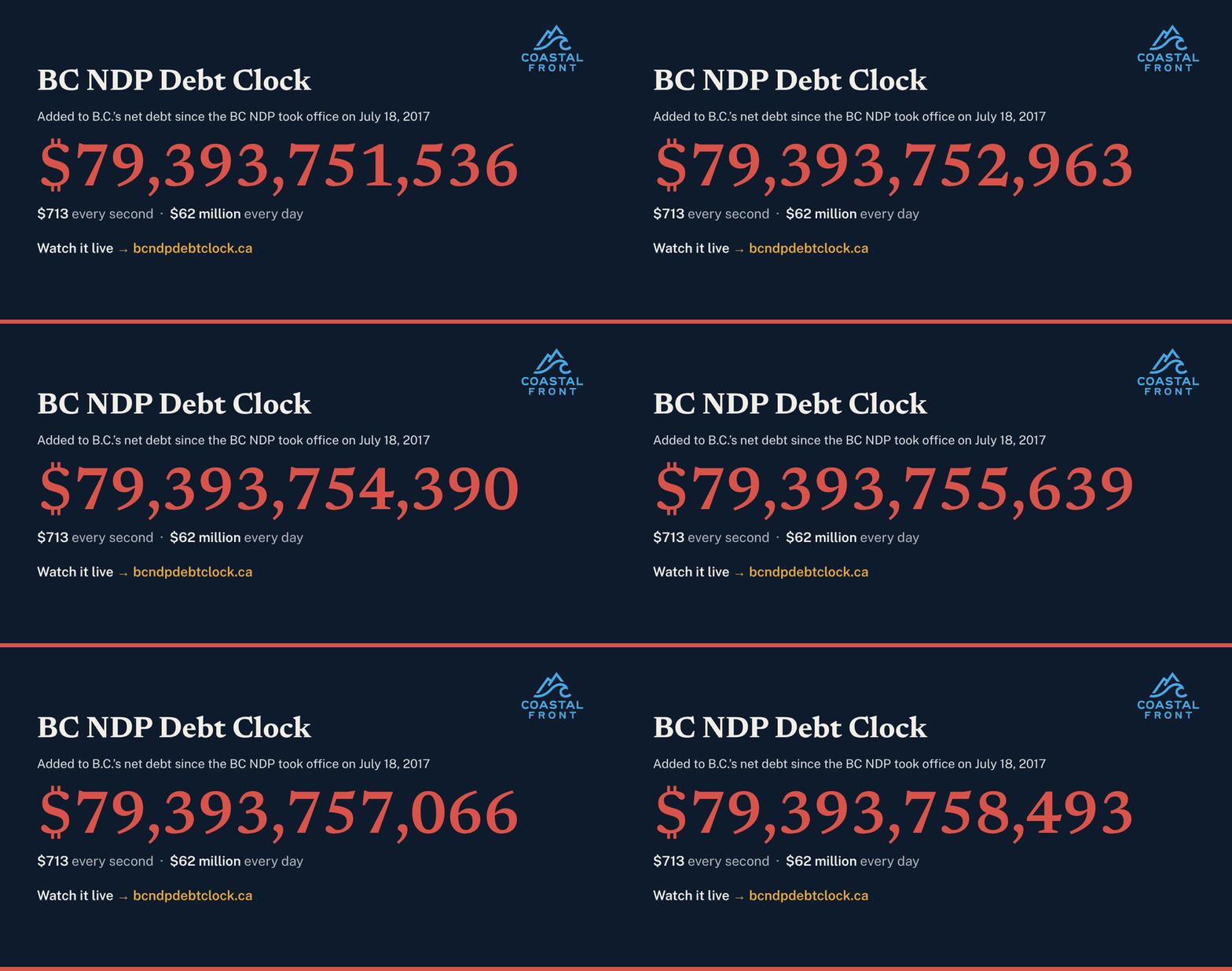
The NDP was voted out on October 24, 2026, but its final budget runs until March 31, 2027, and so does this clock.
How it’s calculated
Dollar figures on this page are rounded to the nearest billion, except the live counters, which show whole dollars. The calculations behind the counters use the unrounded figures.
Net debt is the province’s total liabilities minus its financial assets. It is the measure the BC government itself uses to report its debt. Figures are taken at March 31, the end of each fiscal year.
Net debt was about $38 billion on March 31, 2017, and about $42 billion a year later. Between year-end figures, the clock assumes debt grows at an even rate. On that basis, net debt stood at about $39 billion on July 18, 2017, the day the BC NDP took office. The clock counts up from that point.
The live rate comes from the NDP’s growth forecast for the current fiscal year: from about $106 billion on March 31, 2026, to about $128 billion by March 31, 2027. That is about $713 every second. This counts all net debt growth, including borrowing for capital projects like hospitals, schools and transit, not only operating deficits. Figures after March 31, 2026, are Budget 2026 forecasts. The September 2026 quarterly update raised the deficit forecast by about $450 million, so the true figure may run slightly higher.
John Horgan served as premier from July 18, 2017, until David Eby was sworn in on November 18, 2022. Both led BC NDP governments, so the clock counts continuously across both terms.
The BC Conservatives won the October 24, 2026, election, and Lorne Doerkson is expected to be sworn in as premier on November 24. The 2026–27 deficit and capital plan were set in the NDP’s Budget 2026, and a budget already underway cannot be reversed on a new government’s first day. The clock therefore keeps counting on the NDP’s plan until the fiscal year ends on March 31, 2027, and then stops at its final total. The chart’s figures for later years are the NDP’s own Budget 2026 projections; actual results will depend on the new government’s budgets.
Real borrowing does not happen at an even pace, so the live figure is an estimate.
Sources
Department of Finance Canada, Fiscal Reference Tables, Table 27 (to 2021–22); B.C. Budget and Fiscal Plan 2026/27–2028/29, Table A15 (2022–23 onward); CBC News, July 18, 2017; CBC News, October 2026.