


British Columbia’s luxury vehicle surtax dates back more than three decades. But the structure British Columbians face today is partly built around a base threshold that has not moved since 2006 — and newly released government records raise questions about how well the province has measured whether the tax is actually achieving its goals.
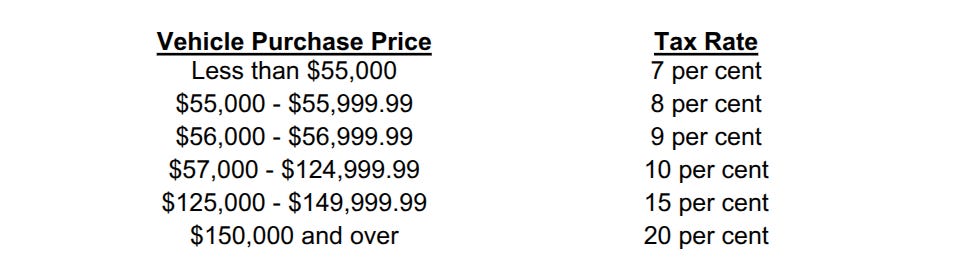
BC’s luxury vehicle tax works by increasing the PST rate as a vehicle’s price rises. For a non-zero-emission passenger vehicle bought from a GST-registered dealer, the rate starts at seven percent below $55,000, rises in steps to 10 percent at $57,000, then jumps to 15 percent at $125,000 and 20 percent at $150,000. The higher rate applies to the full taxable purchase price, not just the portion above the threshold.
The province introduced the surtax in 1993 on vehicles priced above $30,000. The base threshold was last increased in 2006, when it reached $55,000. When PST was reimplemented in 2013, the lower thresholds returned unchanged, and the $55,000 base threshold remains in place for non-zero-emission vehicles. There is no automatic inflation adjustment.
A threshold frozen in time
The vehicle market has changed considerably in the meantime.
According to a September 2021 Ministry of Finance analysis obtained through FOI and based on Statistics Canada data, the average purchase price of a new vehicle in BC rose from roughly $30,000 in 2002 to $49,000 in 2021. The ministry calculated that as a 63.3 percent increase over 19 years, or about 3.3 percent per year on average. It also noted that this was a nominal price increase, not an inflation measure: the Statistics Canada CPI data cited in the analysis showed passenger-vehicle purchase and lease costs had risen by about 13 percent relative to 2002.
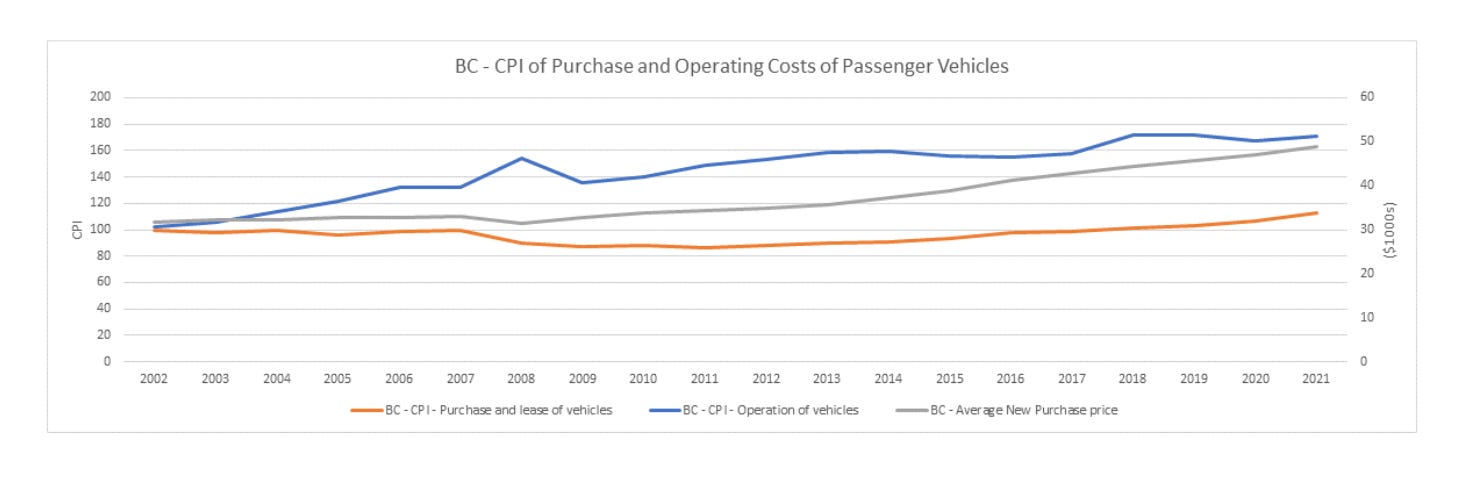
The comparison does not mean the $55,000 threshold should necessarily have risen by 63.3 percent: the threshold was set in 2006, while the ministry’s price series begins in 2002, and there are different ways government could decide where a “luxury” threshold belongs. But the analysis illustrates how much vehicle prices changed while the base threshold remained fixed after 2006.
‘Not luxury items, but essential for families and workers’
That concern has also been raised by the industry.
Internal Ministry of Finance records show the BC Chamber of Commerce and the New Car Dealers Association of BC asked the province to raise the base threshold from $55,000 to $100,000. The Chamber also wanted it increased annually with the Consumer Price Index, while the dealer association argued that many vehicles being caught by the policy were “not luxury items, but essential for families and workers.”
A separate 2022 dealer-association submission cited vans, larger SUVs and pickup trucks used by families, businesses and people in resource communities as examples of vehicles it said were increasingly being captured by the tax. The BC Chamber reiterated its position in a 2024 policy resolution, calling for a threshold of at least $100,000 and regular increases tied to BC CPI.
A major change, however, came in 2018.
For dealer purchases, Budget 2018 raised the PST rate on passenger vehicles priced from $125,000 to $149,999.99 from 10 percent to 15 percent, and doubled the rate on vehicles priced at $150,000 or more from 10 percent to 20 percent. The changes took effect April 1, 2018.
And the government attached a measurable fiscal expectation to them.
Budget 2018’s tax-measures table attributed a $10-million taxpayer impact in 2018/19 and another $10 million in 2019/20 to the increase in luxury surtax rates on passenger vehicles over $125,000.
That prompted an obvious question: did the additional revenue actually materialize?
Coastal Front previously asked the Ministry of Finance how much PST the province collects from vehicles taxed in the 15 and 20 percent brackets. The ministry said it could not provide a breakdown, explaining that it receives PST from ICBC and motor vehicle dealers in lump sums and that the revenue “is not broken down to show the amount of PST that comes from different types of vehicles.”
That answer prompted a broader question: if the ministry cannot provide a breakdown of what the higher luxury brackets collect, what evidence does it use to determine whether the policy is meeting its objectives?
Coastal Front subsequently filed a freedom-of-information request specifically seeking records from 2018 through 2024 discussing the surtax’s efficacy — whether it met its intended policy goals.
The resulting production contains hundreds of pages of briefing notes, policy discussions, industry submissions and internal correspondence, with some material redacted or withheld.
Coastal Front found no clear comparison in the disclosed records between the 2018 revenue estimate and the actual fiscal result.
The missing scorecard
Some of the most revealing records instead show limitations in the information Ministry of Finance officials were using to review the tax.
On September 22, 2021, Tax Policy Branch official Keith Preston wrote that the surtax was frequently raised by the public, industry and legislative committees and that the branch “regularly reviews the appropriateness of the surtax design” through the budget process.
In the same email, Preston wrote that staff relied on publicly available manufacturers’ suggested retail prices and had “relatively little information” about the prevalence of particular makes, models and trim levels in new vehicle sales in BC.
An email exchange from the previous month provides more detail.
Jonah Glass, then director of Data and Modelling Services at the Ministry of Finance, told colleagues the ministry could provide lists of commonly purchased vehicles and that “maybe someone can do some manual work to look up prices.” Another official proposed compiling minimum and maximum prices for popular vehicles to determine which models reached the luxury range and what features pushed them over it.
Those exchanges do not establish that the ministry lacked all relevant sales, registration or tax data. But they do establish that more than three years after the 2018 rate increase, officials reviewing the policy acknowledged having limited information about the make, model and trim-level mix of new vehicles actually being sold.
Collecting less tax as a result?
Meanwhile, within months of the 2018 change, dealers were warning that the higher rates could change buyer behaviour in ways that reduced PST collections.
In October 2018, New Car Dealers Association president Blair Qualey told a legislative committee that, based on conversations with members, “a number” of large dealers selling high-end vehicles had seen what he understood to be a 33 percent decrease in PST collected. He attributed the decline to customers purchasing or registering vehicles in other jurisdictions and argued the government was collecting less tax as a result.
The claim raised broader questions about the surtax’s efficacy: was it reducing BC-taxable sales, shifting transactions elsewhere, or otherwise changing buyer behaviour? Those effects could potentially show up in transaction and registration patterns.
Coastal Front found no clear analysis in the disclosed FOI records examining those effects.
That is notable because the same FOI package shows the Ministry of Finance making forward-looking estimates of other changes to the surtax. In one analysis, officials estimated that temporarily raising the base surtax threshold for zero-emission vehicles to $75,000 would have fiscal-plan impacts of $12 million in 2022/23, $15 million in 2023/24 and $20 million in 2024/25, alongside estimated greenhouse-gas savings.
The province could estimate what a change to the surtax was expected to do. What the released record does not show is a comparable after-the-fact assessment of the 2018 increase. Forecasts alone cannot establish whether a policy worked as intended.
‘Fairness’
Ministry of Finance briefing material says the surtax is intended to improve fairness by asking people who can afford more expensive vehicles to pay more. The government also expected the 2018 increase to bring in more revenue.
That leaves the central question: did the tax actually bring in more money, or did changes in buyer behaviour undermine some of that gain?
Coastal Front sought the government’s own records discussing the surtax’s efficacy — specifically, whether it met its intended policy goals. Yet the material released through FOI contains no clear after-the-fact accounting of the 2018 increase and no clear assessment answering that question.
Government can show what it hoped the tax would accomplish. What the released record still does not show is whether it actually worked — or whether a policy framed as a way to make the tax system fairer may also have eroded some of the revenue it was expected to raise.