


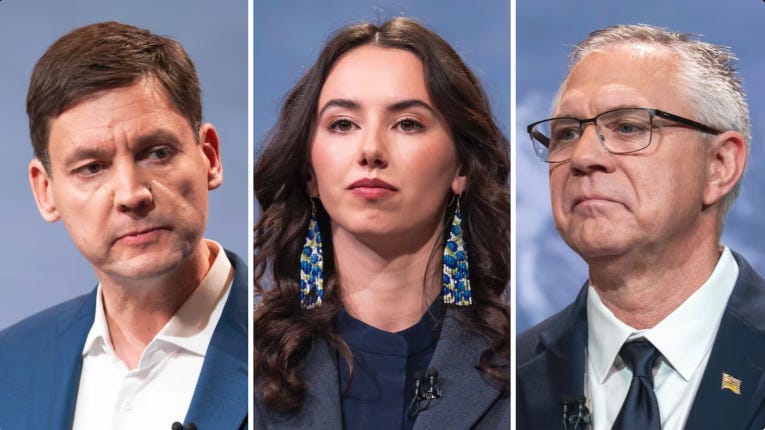
BC’s party leaders offered voters competing routes to lower costs and better services Wednesday night, with David Eby defending the NDP’s spending record and his challengers questioning why another round of promises would produce different results.
The only scheduled televised leaders’ debate before the October 24 election brought Eby, interim Conservative leader Lorne Doerkson and Green Leader Emily Lowan together in Vancouver. Their proposals face a common financial constraint: the province is forecasting a record $13.8-billion deficit for 2026–27.
The September fiscal update put the projected shortfall $450 million above the February budget estimate. The Finance Ministry identified higher wildfire spending and refundable tax-credit costs among the pressures, alongside economic uncertainty from U.S. tariffs and other international disruptions. The figure is a forecast for the fiscal year, not a final audited result.
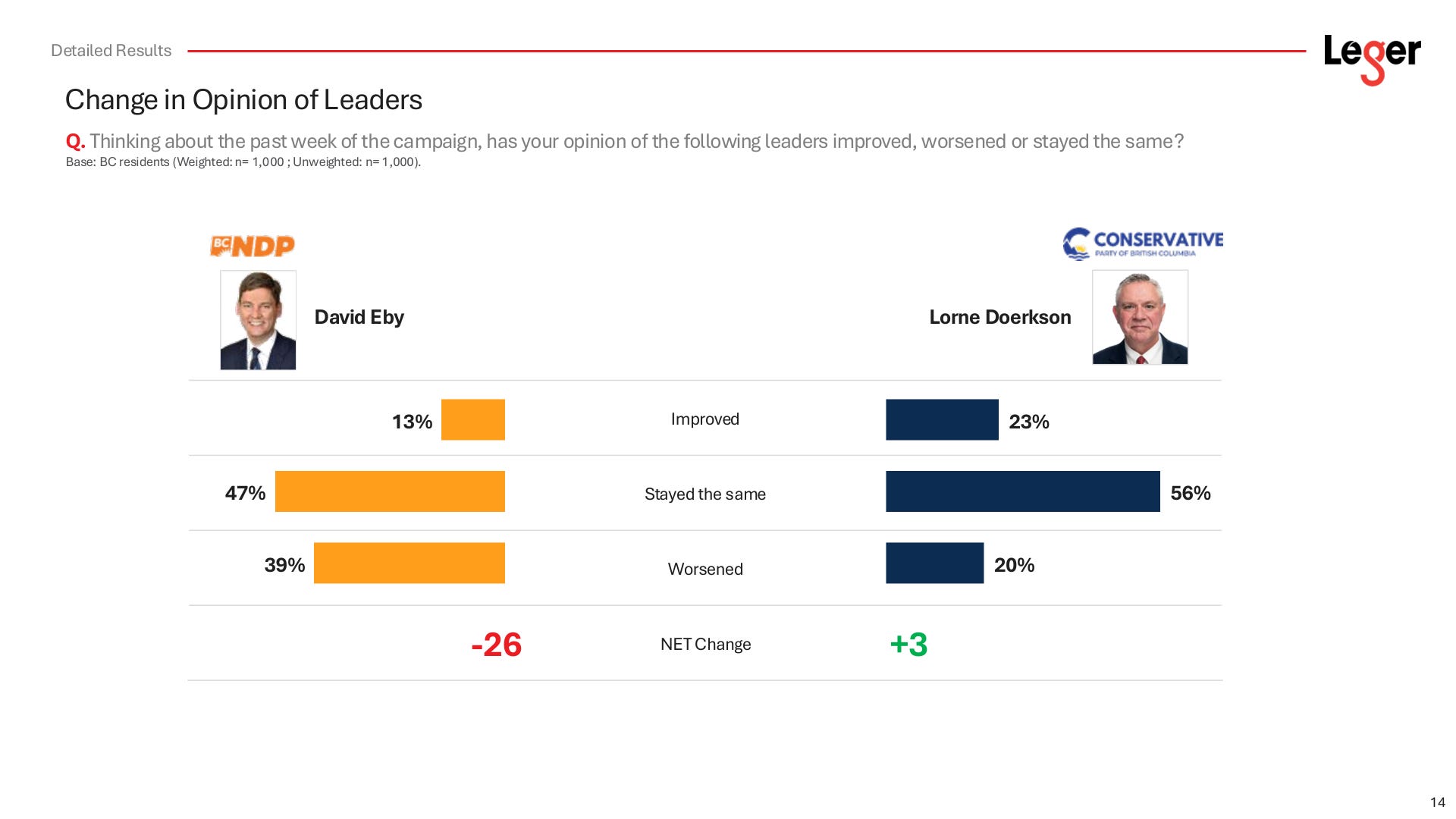
Eby argued that public spending had supported schools, hospitals and services, and warned against balancing the books through cuts that would hurt residents. Doerkson challenged the NDP to answer for its years in government, while Lowan questioned whether its latest commitments would survive beyond election day. The government’s September update also reported that 23 new schools and additions opened in September, providing space for 4,700 students.
Who pays for the promises
The NDP’s campaign costings, released hours before the debate, project a deficit of about $12 billion in 2028–29, The Canadian Press reported. That would be a reduction of roughly $2 billion over two years, leaving a large gap between provincial revenues and expenses.
The party says economic growth and higher taxes on the top 3.88 percent of income earners would pay for its new commitments. The plan does not project a balanced budget within those two years.
Doerkson’s alternative centres on lower taxes and faster growth. The Conservatives propose raising the provincial basic personal exemption from $13,216 to $32,000. The party says the change would cut annual provincial income taxes by about $1,000 for nearly every working British Columbian.
The Conservatives had not released complete platform costings by Wednesday’s debate. Eby repeatedly pressed Doerkson to explain how his promises would be financed. Speaking to reporters afterward, Doerkson said the platform would be released before people had an opportunity to vote. He argued during the debate that economic expansion would help reduce the deficit.
Lowan proposed a larger shift toward taxing wealth. The Greens’ published platform estimates that a one-time progressive levy on net wealth above $50 million would raise $22.2 billion, followed by annual wealth taxes generating about $5.4 billion a year. Those are party projections; the revenue would depend on implementing the taxes and collecting the amounts forecast.
Old promises face fresh scrutiny
The Greens would use additional revenue to support measures including universal child care, expanded transit and social housing. Lowan’s criticism of the NDP drew on a specific reversal in seniors’ care: seven long-term care projects paused by the government earlier this year are now the subject of a renewed election commitment.
The projects, in Abbotsford, Campbell River, Chilliwack, Delta, Fort St. John, Kelowna and Squamish, were put on hold in the February budget. The NDP now promises to move them forward, citing funding secured through a July agreement with Ottawa and a different construction model intended to reduce costs.
“This year’s election bribes are next year’s broken promises,” Lowan said during the televised debate.
Eby’s healthcare pitch includes tripling funding for the province’s U.S. recruitment campaign and adding 500 workers to expand home care. The Greens promise an integrated community health centre in every riding. Doerkson has proposed a $50-million emergency fund to help prevent rural service closures and support recruitment.
The affordability debate carries another example of a commitment that did not materialize. In February 2025, the government cancelled its promised $1,000 grocery rebate for households. Then-finance minister Brenda Bailey cited uncertainty over threatened U.S. tariffs and the need to preserve resources for core services.
On housing, the disagreement extended to how much government should direct construction. Doerkson argued that provincial rules had made building unnecessarily difficult; Eby countered that rolling back those rules would add bureaucracy. The Greens’ platform calls for restarting community and Indigenous housing funds, with a goal of building and protecting 26,000 homes a year.
Car insurance provided another direct comparison. The NDP promises to extend the freeze on basic ICBC rates for three more years, until spring 2030. The Conservatives propose a hybrid insurance system that would give people with serious injuries greater access to legal representation, alongside more consumer choice and a continuing public ICBC option.
The Conservative policy says the model would improve compensation while protecting affordability. Eby argued that reopening the system to more litigation risked higher premiums. Doerkson said during the debate that he would cap lawyers’ fees and keep rates competitive.
The race to election day
The leaders’ arguments about economic certainty also reached the Declaration on the Rights of Indigenous Peoples Act, known as DRIPA. Section 3 of the 2019 legislation requires the government, in consultation and co-operation with Indigenous peoples, to take measures to make provincial laws consistent with the United Nations Declaration on the Rights of Indigenous Peoples.
Doerkson promised repeal, arguing that the law had created division. Eby defended partnerships with First Nations as essential to advancing major projects. Lowan backed implementation, citing First Nations’ calls for the province to do that work.
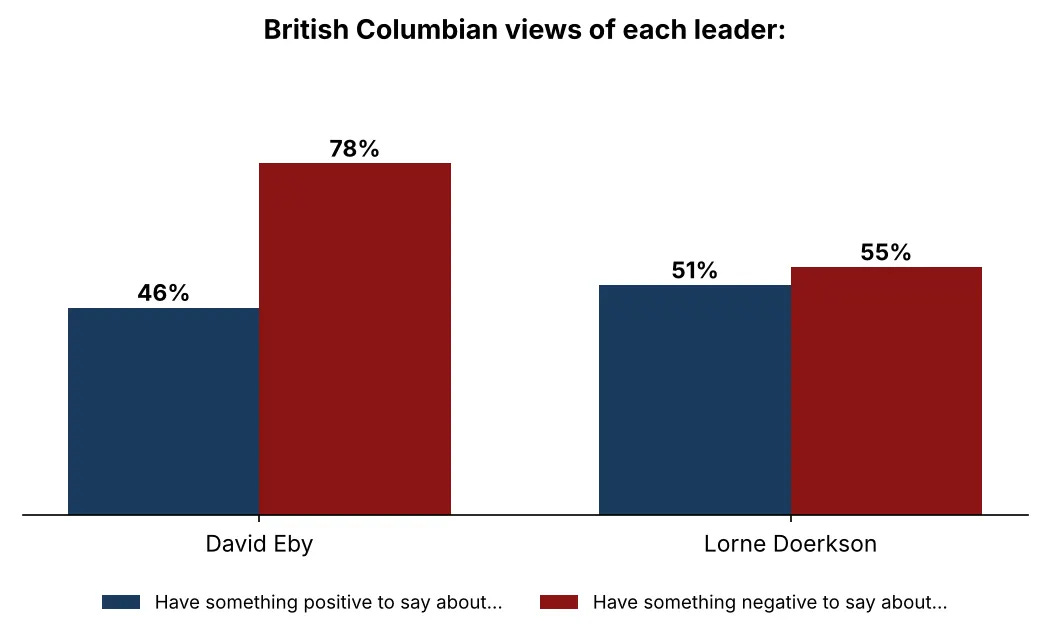
Asked why he had called an election only two years after the last vote, Eby argued that the NDP’s narrow majority limited its ability to act amid U.S. economic threats. Doerkson described the election call as opportunistic.
Speaking to reporters after the debate, Eby said, “I need a strong mandate from British Columbians.”
Lowan, meanwhile, said electoral reform would be a priority if the Greens held the balance of power in a minority legislature.
Polling conducted before the debate showed the Conservatives ahead, with the size of the gap varying by survey. Leger’s October 9–12 online poll of 1,000 BC adults put Conservative support at 42 percent among decided voters, the NDP at 40 percent and the Greens at nine percent. Leger also found 26 percent of respondents said they were likely to switch their vote. Leger says a conventional margin of error cannot be assigned to its non-probability sample.
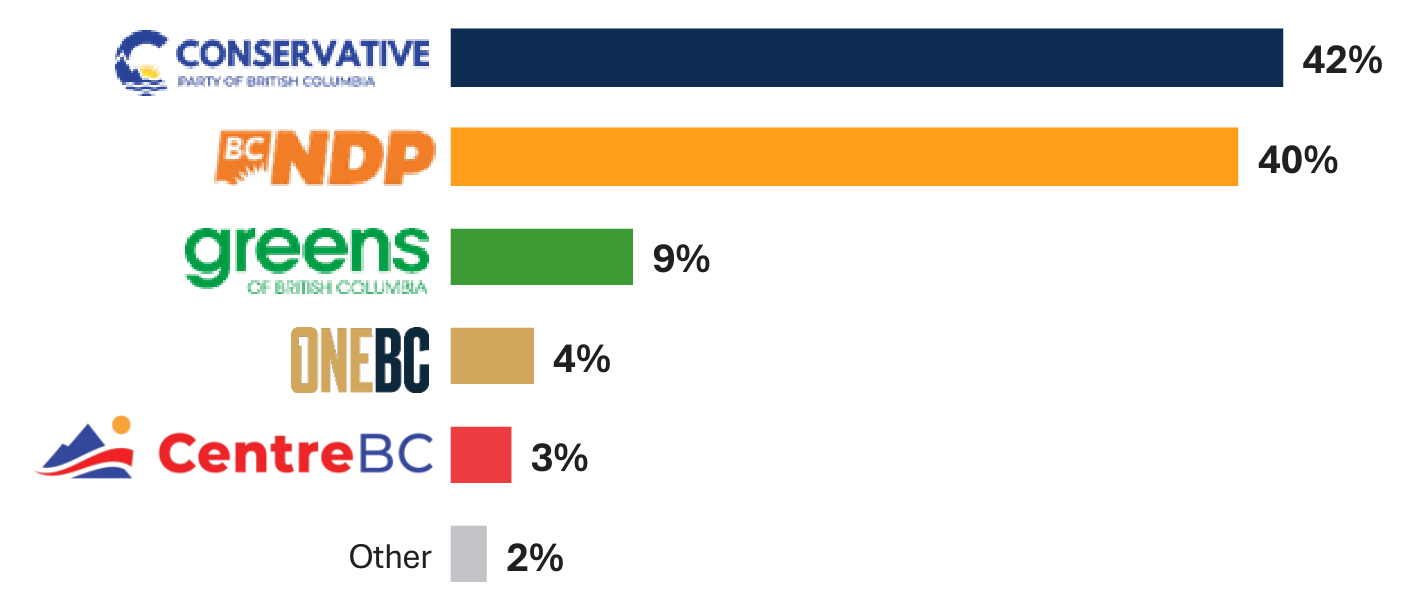
An Ipsos survey conducted October 7–11 for Global BC put the Conservatives at 43 percent, the NDP at 38 percent and the Greens at 11 percent among decided voters. Neither poll measured the debate’s effect.
Voters can begin making their choices at advance polls from October 16 to 21. Final Voting Day is Saturday October 24, according to Elections BC.
In September 2024, ahead of the last provincial election, Coastal Front sat down with Eby for an exclusive interview about BC’s deteriorating finances. The latest reported year-end total provincial debt was already $107.46 billion.

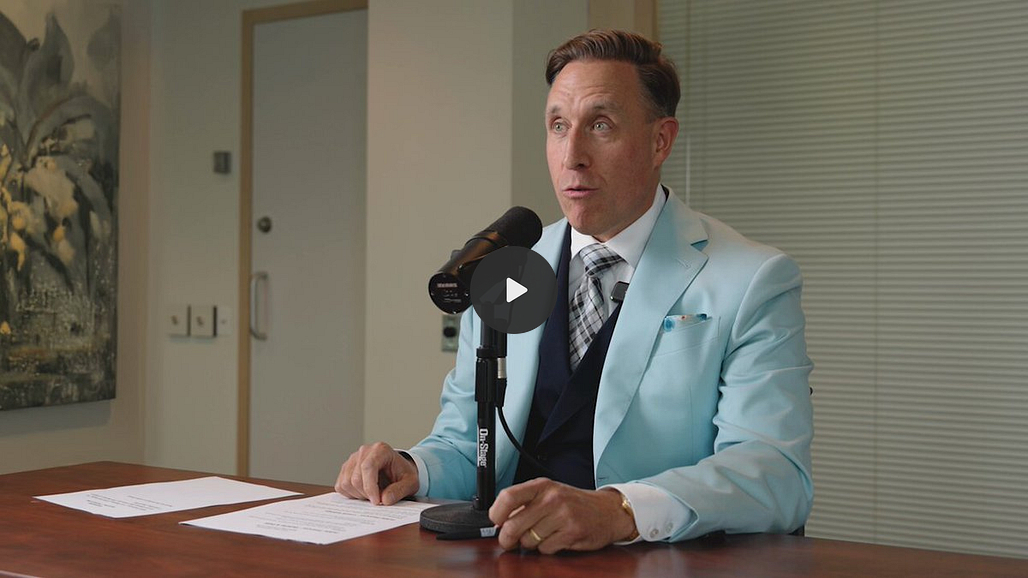
We asked whether he intended to cut spending. Eby defended borrowing for infrastructure. Later, when we asked whether his government would eventually reach a balanced budget, he answered: “Oh, absolutely.”
Pressed for a timeline, he said: “Our goal is within the next term of government to be back to balance.”
That term is now ending early. BC remains in deficit, and the government projects no balanced budget through 2028-29.