



The federal contract to shift Employment Insurance onto a new computer system started at $94.3 million and is now worth up to $452.6 million. After ten amendments, Accenture’s deal stands at 4.8 times its original value, with more than three years left to run.
It is one piece of the Benefits Delivery Modernization program, which is replacing the computer systems behind Employment Insurance, the Canada Pension Plan and Old Age Security. The program’s estimated cost has gone from $1.75 billion in 2017 to $6.6 billion. Officials say there are no cost overruns.
The government attributes the rise partly to added scope, such as migrating ESDC’s 14 call centres. On October 5, Cliff Groen, Service Canada’s chief operating officer, said that, given what was known then, “the total cost of the program is expected to be less than the $6.6-billion forecast.”
At least part of the cost falls on the Employment Insurance account, which is funded by employers and employees. A quarterly financial report from Employment and Social Development Canada (ESDC), which runs the program, said more of the program’s spending was charged to that account in April to December 2025 than a year earlier.
Ten amendments, one end date
Public Services and Procurement Canada, the government’s buying department, signed the contract with Accenture Inc. in February 2025 on behalf of ESDC. The original value was $94,261,035.05, for work to plan, design, build, test and maintain the new Employment Insurance system until March 31, 2030.

The amendments came almost every quarter. The latest, reported for July to September 2026, added $124.7 million, more than the starting value. In total, the amendments come to $358.3 million. The end date has not moved.
At a Commons committee hearing in October, the procurement department put the contract’s “current contract value” at “$393.6 million plus taxes,” in the official English transcript. That figure matches the published $452.6 million once sales taxes are added, by Coastal Front‘s calculation.
The records say when each change was reported, not when it was signed or what it bought, and they may not all be new work. Work under the contract is ordered in pieces, called task authorizations. When it is unlikely such a contract’s full value will be used, Treasury Board guidance says, “the value of any subsequent task authorization may be reported as an amendment.”
So the ten amendments may be planned phases of the work competed in 2024 rather than added scope; the records do not say which. Either way, the published ceiling has nearly quintupled.
The amount paid “may be less than the amount proactively published,” the record says, and the values appear to include sales taxes, as federal disclosure guidance recommends. How much Accenture has been paid under this contract is not public. An ESDC binder prepared for the minister’s March 2026 committee appearance put spending with the company across all its program contracts at $202,430,181.77 as of February 2026.
Competed once, grown since
In 2019 the government pre-qualified four technology firms, Accenture, CGI, Deloitte and Fujitsu, as “system integrators” for the program, and signed master contracts with them in early 2021. “We had six suppliers that showed interest, and we ended up negotiating contracts with four of them,” Joëlle Paquette told the Commons public accounts committee on October 5. She is an acting associate assistant deputy minister in the procurement department.
Employment Insurance was then competed among those four “at the beginning of 2024,” she said, and Accenture won. The disclosure lists zero bids. Treasury Board guidance lets departments enter zero, meaning not applicable, when the bid count for a task-authorization contract is unknown.
Other Accenture program contracts include two smaller ones that name Employment Insurance. One is a $32.0-million planning contract from 2024, recorded as non-competitive and, the record says, one of four directed task authorizations, one to each firm. The other is a $1.3-million internal chatbot. Planning work “is not necessarily competed on by the four,” Paquette said.
‘No cost overruns’
A 2023 audit by the Auditor General called the program the “largest information technology project undertaken to date by the federal government.” By April 2022, the program’s estimate had already reached $2.5 billion, up 43 percent from 2017 “even though no benefits had yet moved to the new platform,” the audit found.
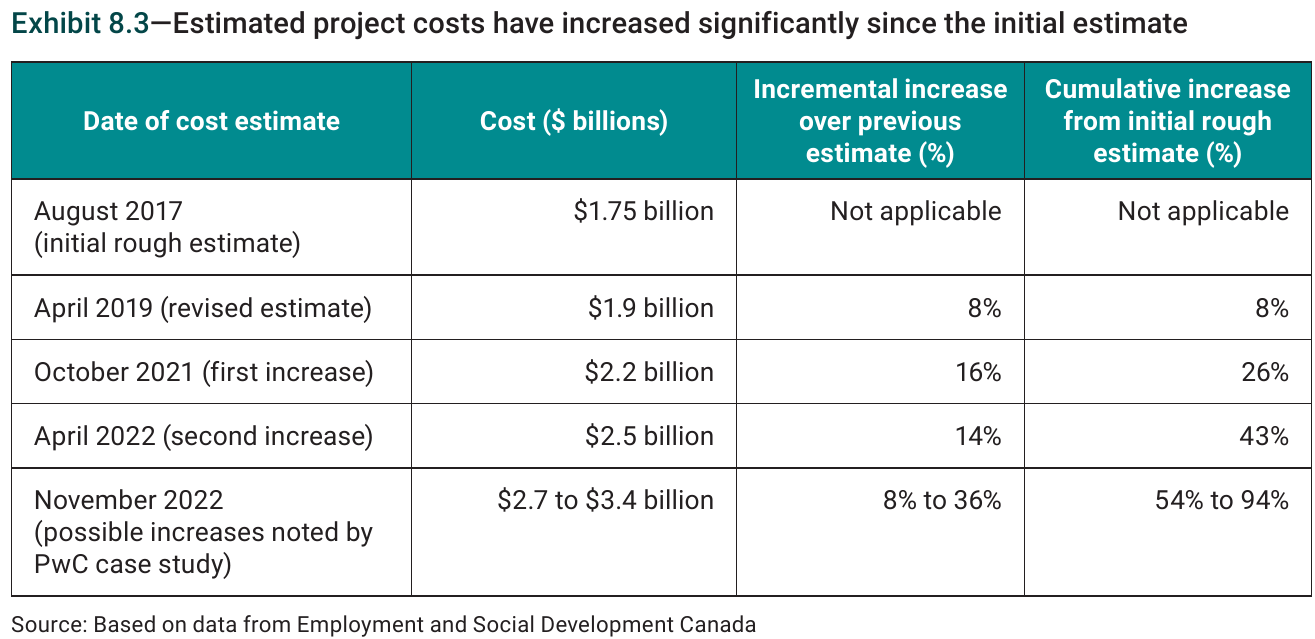
The program’s estimated total cost, called its program authority, now stands at $6.64 billion through 2030-31. The government’s response to the public accounts committee, tabled February 5, 2026, says that figure “does not, in and of itself, convey authority to expend funds.” Its cost table estimates $2.31 billion for moving Employment Insurance between January 2024 and December 2028, plus a $546.1-million contingency.
Groen also told the committee that the program authority “also includes contingency funding, which has not been required to date.” He said $2 billion had been spent on the program by June 30, 2026.
The first Employment Insurance benefit moved to the new platform in fall 2025, and full migration is due in 2028; until then, existing clients stay on the old systems, the binder says.
At the Commons human resources committee in May, Bloc Québécois MP Andréanne Larouche asked “who writes the cheques when costs start to spiral out of control?” Groen replied: “As I’ve said multiple times, there are no cost overruns.” The exchange was in French; this is the official English translation.
In March, Jobs and Families Minister Patty Hajdu told the same committee that “costs have remained stable and well managed.” She also said that “every contract includes clear deliverables, financial caps and phased work” and that “all contracts are competitively awarded and proactively disclosed in accordance with the rules in place.”
What the amendments buy is not in the public record.