


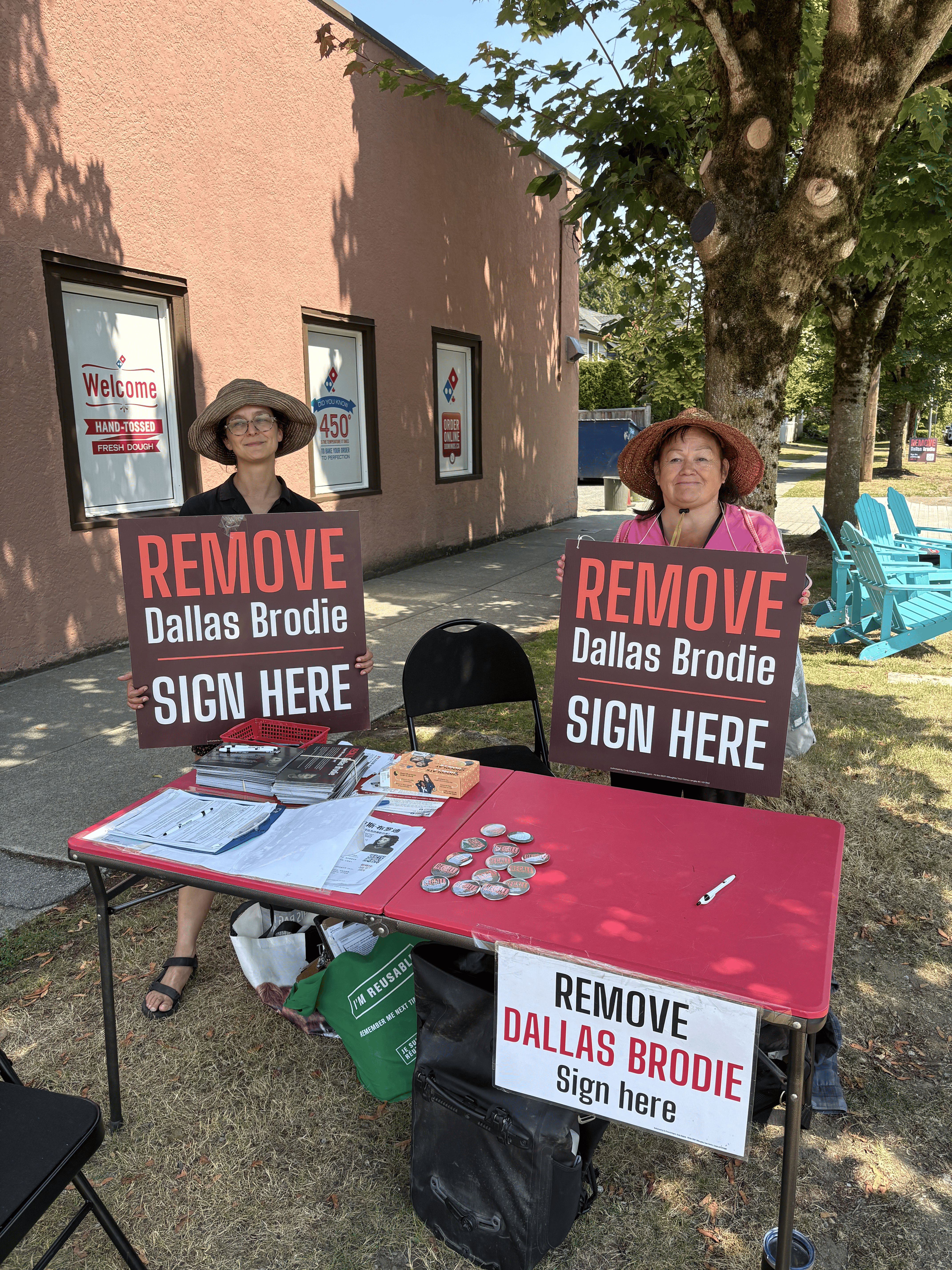
In the provincial riding of Vancouver-Quilchena, a movement has been brewing against the sole MLA elected there, Dallas Brodie. The Recall Dallas Brodie campaign is a grassroots movement dedicated to using the provincial Recall and Initiative Act to remove Brodie from power and trigger a by-election to choose a replacement MLA.
“Having people in power who behave in that way, I feel, is quite dangerous for our democracy in general,” said Zoé Kruchten, a volunteer in the campaign. “Regardless of where on the spectrum politically they are, I think that when you’re using fear to gain power, stoke resentment and create divisions in society, it’s bad for all of us in general,” she continued.
On July 20, it was announced that the Recall Dallas Brodie campaign had failed to meet the 15,000-signature threshold from registered voters to trigger a recall and subsequent by-election. The campaign reportedly submitted a little over 3,600 signatures on the petition in total.
While the campaign has concluded for now, many are still unaware of what is happening in Vancouver-Quilchena. What spurred this campaign? What did MLA Brodie do to incur this sort of movement against her? Coastal Front took a look inside the Recall Dallas Brodie campaign to find out more.
Who is Dallas Brodie?
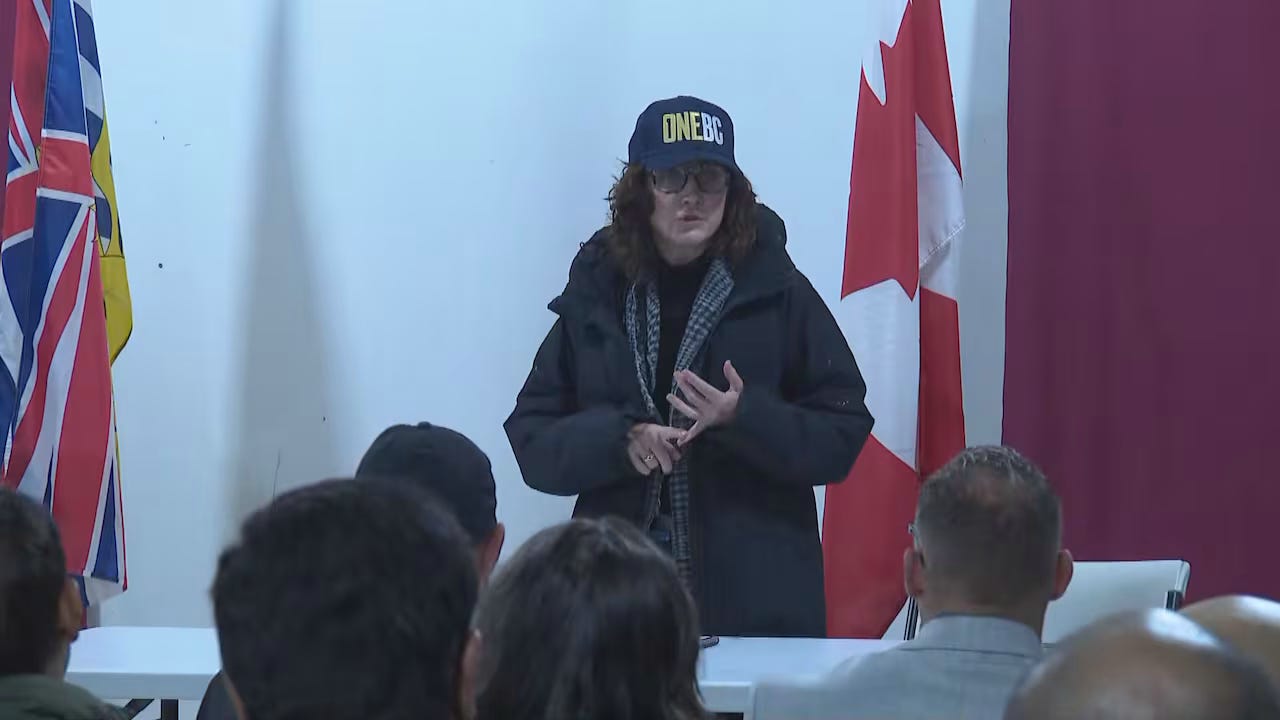
Brodie is a former BC Conservative MLA, ousted from the party in 2025 by then-leader John Rustad, only half a year after the 2024 provincial election. In that election, she became the MLA for Vancouver-Quilchena. Brodie had been removed from the Conservatives because of her mocking the testimonies of residential school survivors in an appearance on a YouTube podcast.
Since then, she and Tara Armstrong—another MLA who left the Conservatives, partnered together to create a new party: OneBC. OneBC’s politics are publicly associated with right-wing populism and social conservatism. They have proposed bills such as the Land Acknowledgement Prohibition Act or the Protecting Minors from Gender Transition Act. None of their proposed bills have passed and have been voted down in legislation.
After a period of internal strife in December of last year, Brodie was internally removed from OneBC by the board of directors. In the end, Brodie was reinstated after eight days, and Armstrong, along with some senior members of the board, left the party in the aftermath.
Dr. Susan Burgess, a volunteer within the movement, told Coastal Front how after Rustad kicked Brodie out, “she was unleashed.”
“Elected, then kicked out, kicked out again, still continuing,” she added.
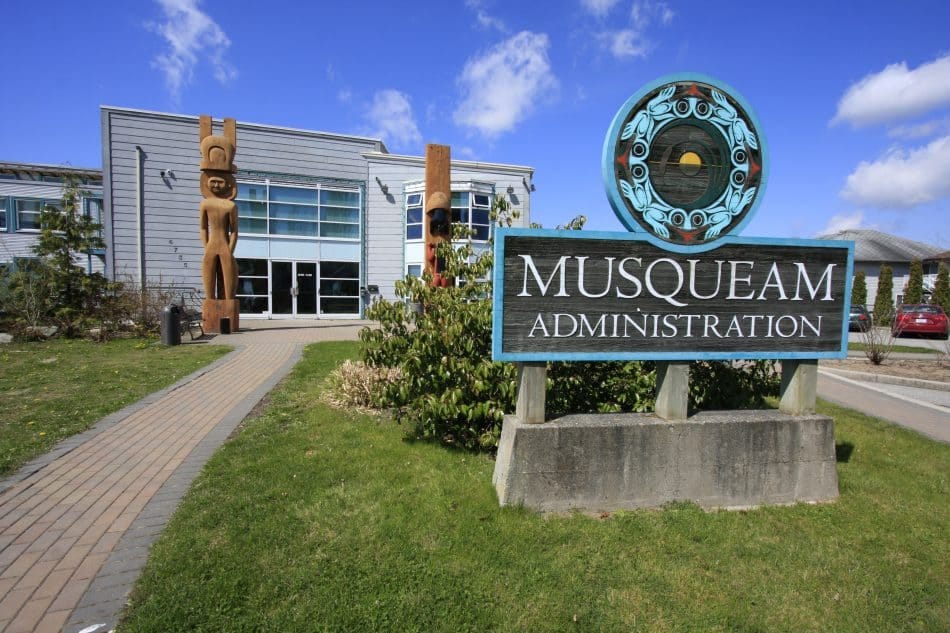
During this time, the Musqueam Council and Chief Wayne Sparrow (whose lands overlap with Vancouver-Quilchena) openly called for Brodie’s resignation and reflection on her words and actions over her residential school denialism.
“Our leaders carry themselves and the business of our people in an honourable and respectful manner,” the collective statement read. “We expect the same from all public officials. Denialism and anti-Indigenous rhetoric have no place in the Legislature.”
Since being elected in October 2024, Brodie has neither opened a constituency office in her riding nor has she barely even answered email inquiries relating to local issues in Vancouver-Quilchena, according to some of her constituents.
Burgess noted how Brodie had previously failed to address the concerns of citizens in the riding. In the Vancouver-Quilchena riding, she pointed out how many senior citizens live in the area who have needs to be addressed.
Burgess also pointed to a shortage of family doctors in the area and the crucial need for Automated External Defibrillators (AEDs) in children’s elementary schools for emergencies. These material needs have not been addressed by Brodie, she pointed out.
“I might not need help, but my neighbours might. That’s the point of being a representative for your constituents,” summarized Burgess.
Through OneBC’s provincial party status, almost $650,000 in taxpayer funding has been granted to the party of one— two at the time of its inception. Although the full scope of what these funds have been used for hasn’t been disclosed by OneBC yet, it has been speculated that Brodie used the funding for her documentary “Making a Killing.”
Brodie’s documentary uses residential school denialism rhetoric and claims to uncover a “massive scandal behind the taking of wealth, land, and power from the Canadian public to benefit indigenous tribes.”
While some residential school sites have yet to provide evidence of bodies, a child’s remains were discovered at the former Blue Quills residential school site in Alberta, and a child’s jawbone fragment was verified at the Lebret residential school in Saskatchewan.
The Truth and Reconciliation Commission has identified 3,200 deaths of named students at these schools and estimates that just under one-third of total deaths didn’t even have their names recorded.
While Brodie hasn’t opened a constituency office, she has been “touring” the province to other ridings, speculatively on the taxpayers’ dime as well. Most recently, she went to town halls in other municipalities like Kamloops and Prince George for OneBC’s “Backbone of BC Tour.”
In an email response to a concerned constituent, Brodie’s staff did not disclose how much was spent on the documentary and claimed that it presented “diverse views” and encouraged “respectful dialogue.”
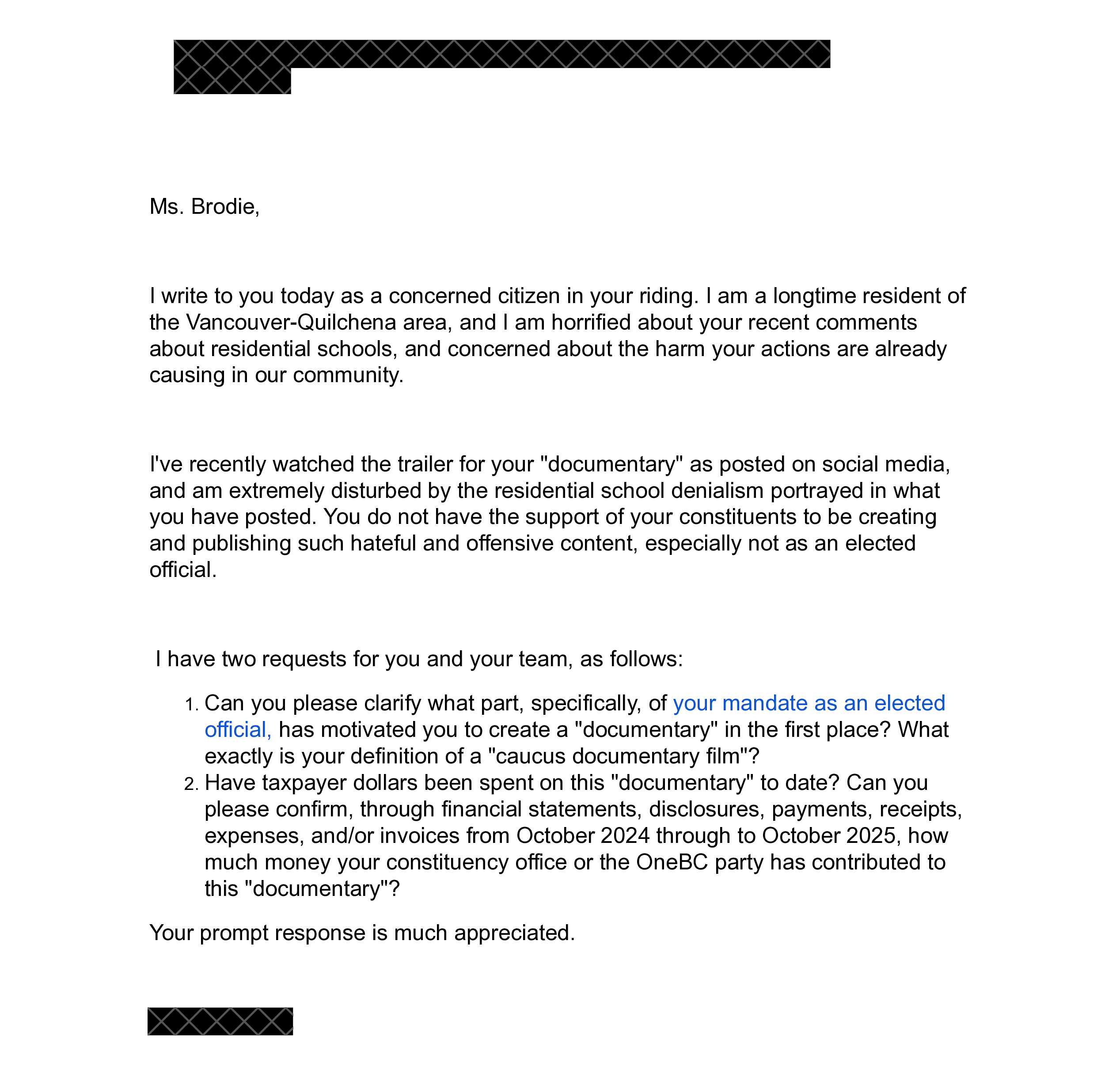
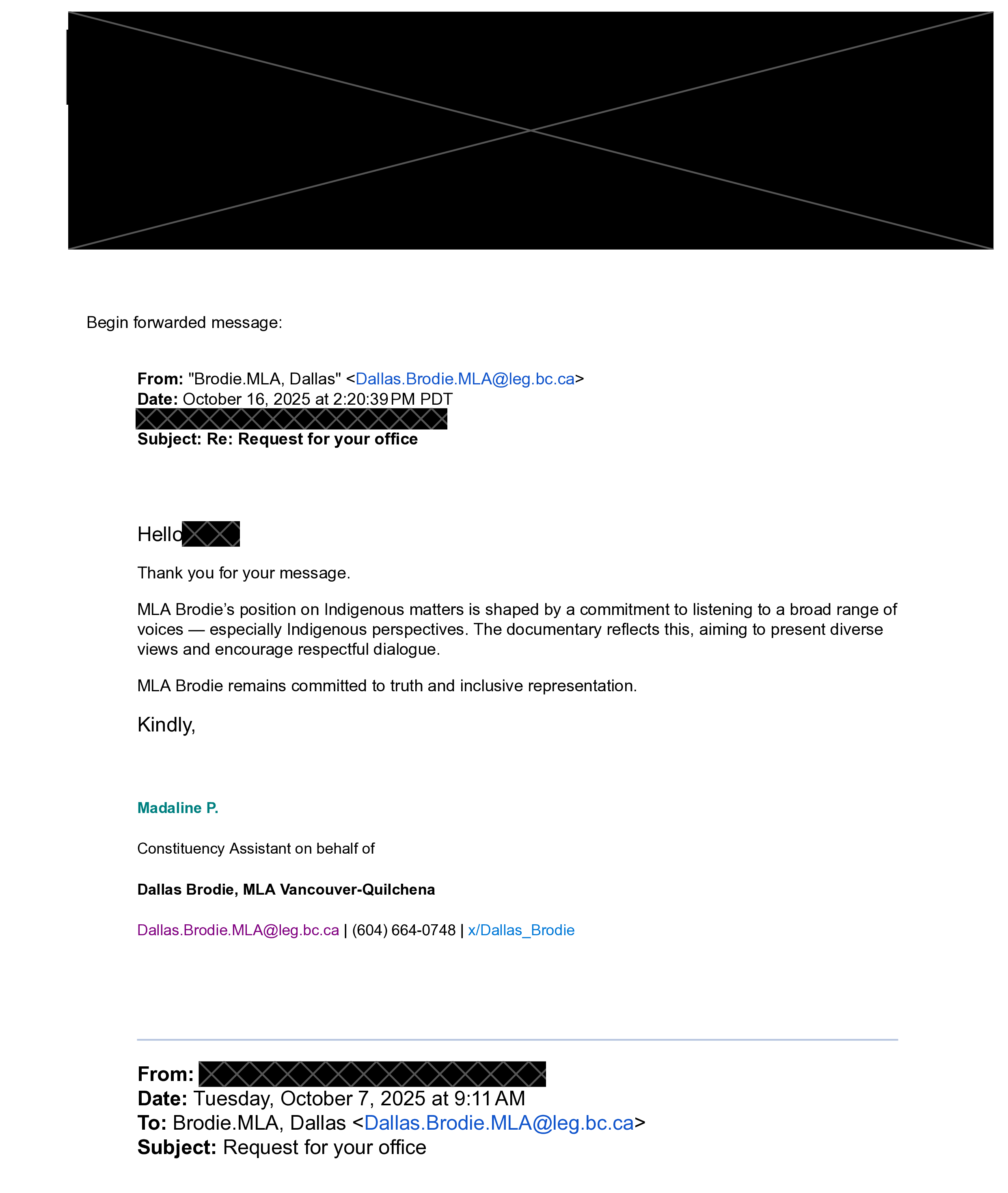
Those in the Recall campaign emphasize that this is a blatant misuse of taxpayer dollars and political effort. “If you ask the residents of Vancouver-Quilchena, would they rather see a documentary or would they rather see AEDs in elementary schools?” inquired Erin, a Recall volunteer.
Mike Farnworth, NDP House Leader, spoke on the matter of public funds being used for Brodie’s political commentary and career to CHEK News.
“Right now, they are able to do that as elected MLAs, in terms of how they use their caucus funds, but certainly it’s something we could be taking a look at,” he said. “Because quite frankly that’s never really what the caucus funds have been intended for.”
The Campaign
The Recall campaign is entirely volunteer-led, with many of the participants donating their time outside of their own personal jobs. The financial agent for the movement is the only “employee” on the payroll who previously worked for the BC NDP, a fact that Burgess transparently disclosed to Coastal Front.
The movement was organized by Dorothy Cumming, a retired nurse and instructor at BCIT, as well as a resident of Vancouver-Quilchena for 45 years. In a public statement, she said, “Residents have raised concerns that they don’t see an engaged MLA on meaningful engagement or advocacy on everyday issues facing families, seniors, renters and businesses. We have not seen an MLA working to support healthy, vibrant schools for all school children.”
The movement stresses itself as being bipartisan, made up of NDP, Conservative, and Green Party voters altogether. Multiple volunteers who spoke to Coastal Front all confirmed this, some even voted for Brodie in 2024.
Instead of Brodie representing her constituents, said Erin, “she’s doubling down, promoting branding and marketing for her own party, her own ideological values, and has since abandoned any of the campaign promises that she platformed on and the promises she made to the residents.” This has brought community members and even volunteers outside of the riding, like Erin herself, from all different backgrounds into this movement.
“I myself am a member of Syilx Nation,” she said, “so her really harmful comments and rhetoric around mocking residential school survivors became immediately of interest and a huge concern for me.”
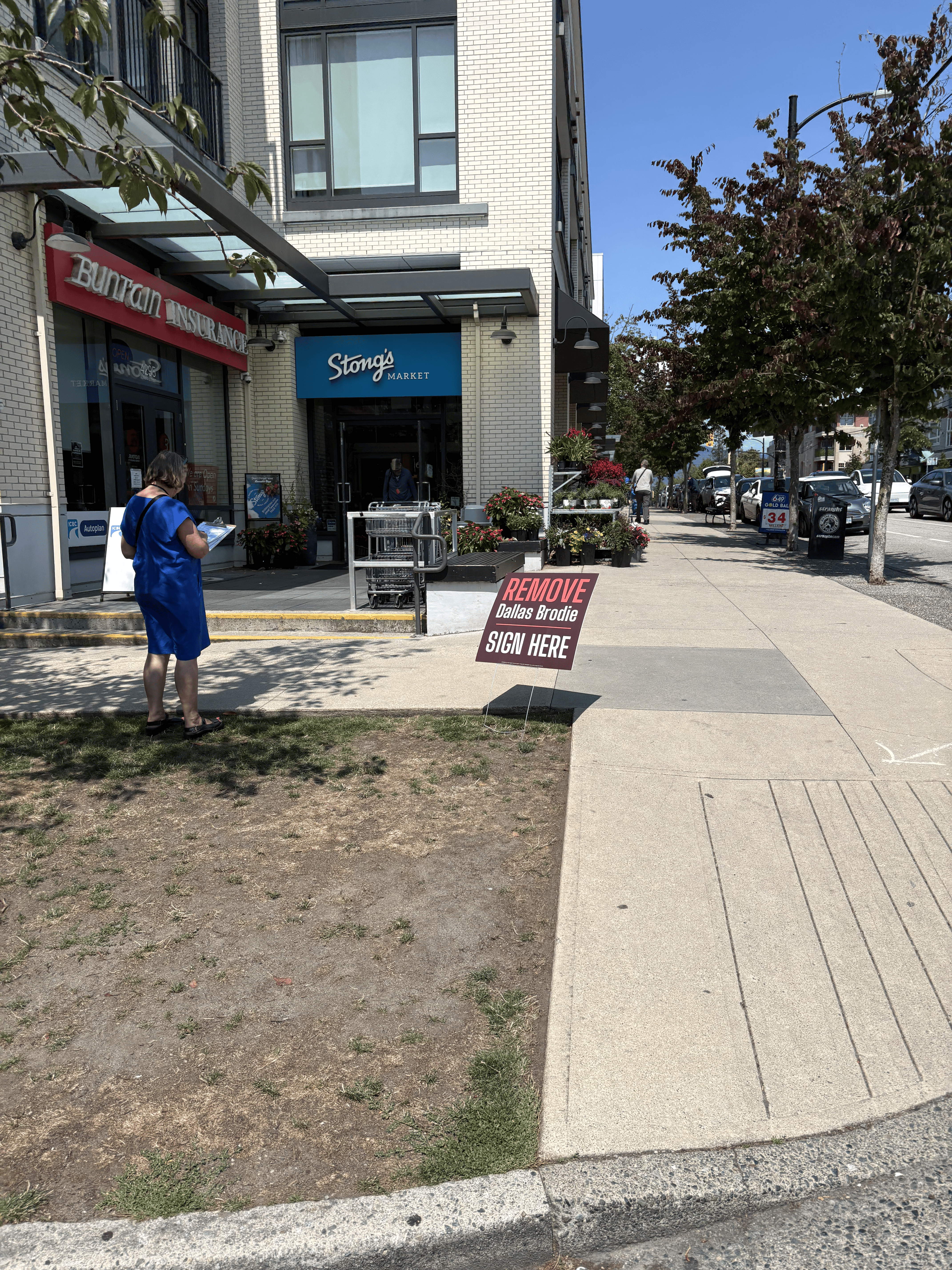
During the time since the campaign announcement in May, volunteers have been canvassing, engaging unaware constituents, and setting up petition signings in various neighbourhoods around the riding. At these sites were enthusiastic volunteers holding up signs to grab the attention of passersby.
In the past two months or so of organizing, you could see many “Recall” signs in the front yards of residents in Vancouver-Quilchena.
However, Brodie also has many loyal supporters in her riding as well. Many volunteers in the Recall campaign have reported they face harassment from plainclothes OneBC staffers or supporters. Typically, they did not identify as either and instead told volunteers they were “just asking questions.”
Kruchten said they often yell at volunteers for being on public property and described them as being “very hostile people.”
She even described how, on a few occasions, some of these people disingenuously filled out forms related to mobility issues, so that canvassers could show up at their homes for petition-signing. They would then start “asking questions” with the canvassers rather than signing the petition. This made volunteers within the campaign quite uncomfortable, according to Kruchten.
“I’ve been yelled at, frankly, a lot on shift, including hurtful comments about residential schools and disparaging comments about the Kamloops Residential School, which is where my family went to residential school,” said Erin.
Masha Kleiner, an identified member of Brodie’s staff, was allegedly subjecting volunteers to “abusive and hostile behaviour, including unethical conduct,” according to a statement from the campaign.
Brodie herself was publicly called out by a then-Conservative MLA, Amelia Boultbee, for being harassed and filmed by her in a public space, back in October 2025.
Issues with the system
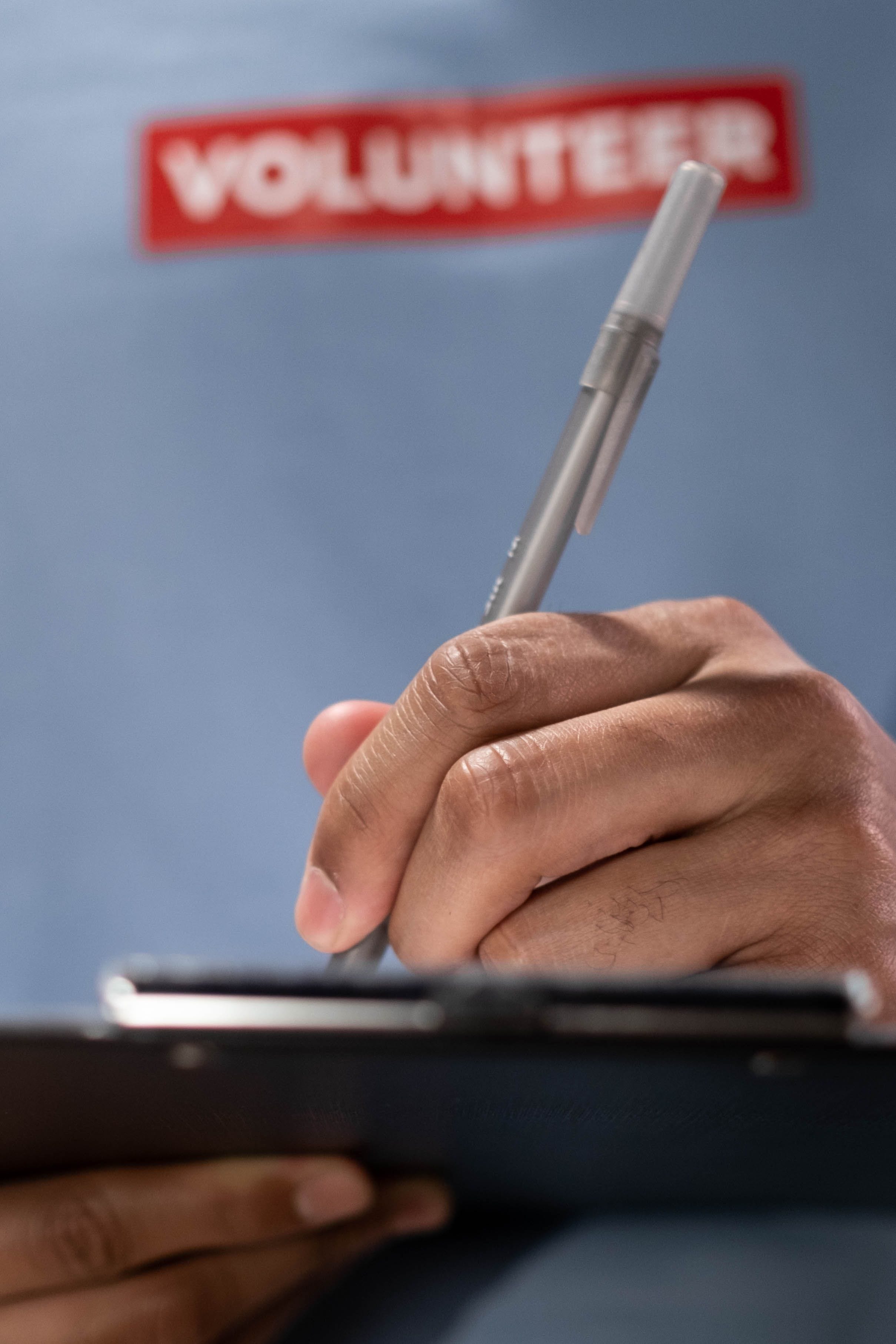
Before the results of the petition signing were announced, volunteers like Kruchten expressed frustration with the whole system of recalling MLAs in BC in general.
“There’s been a lot of attempts, but it’s never been successful, and I’m kind of like, ‘Well, maybe we should question why it’s never been successful,” she said.
Kruchten acknowledged that it shouldn’t be too easy to get an MLA recalled, but there needs to be a balance in comparison to the current system, which is difficult for several reasons.
Under the Recall and Initiative Act in BC, a campaign only has 60 days to get the signatures of at least 40 percent of constituents who were eligible to vote in the 2024 provincial election. Absolutely no advertising for the campaign can be done before it is approved for those 60 days. As mentioned earlier, for Vancouver-Quilchena, this 40 percent was 15,000 signatures from voting constituents.
Kruchten also pointed out how the Act can prevent volunteers from reaching certain populations. In retirement homes, for example, the building’s staff can refuse entry to volunteers without consulting any of the elderly people living inside the building and constituency.
She also discussed how vulnerable populations could be barred from participating in the petition, as it does not allow mail-in signatures, and the system of signing from home can be abused, as previously mentioned.
Kruchten wanted to make it clear that Elections BC, as an institution, has been helpful in answering questions and providing information to the Recall campaign. It’s the legal framework for MLA recalls outlined in the Act that was the true difficulty for them.
What’s Next?
With the petition’s signatures not being able to meet the threshold, it is uncertain where the campaign will go next. The next provincial election is slated for October 2028.
In a statement to Coastal Front responding to the final petition signature count, Brodie said: “I didn’t lift a finger or spend a penny opposing the recall and they still failed miserably.”
She continued, “I have to thank them for making more British Columbians aware of my record of standing up for property rights and against the Reconciliation Industry that is dividing our province socially and geographically.”
The aforementioned Masha Kleiner said OneBC’s future election strategy will be targeting ridings “hardest hit by the BC NDP.” She said they have apparently identified “thousands of supporters” in several ridings, which they will be utilizing in future elections.
While the Recall supporters and volunteers aren’t thrilled by the results, there was a lot of communal optimism
A statement from the Recall campaign reads that “this campaign mobilized and connected residents who are now more engaged than ever in the democratic process”. It continued, “members of the team will provide feedback and suggestions to update the Recall and Initiative Act to Elections BC and to legislators to be more in line with the Election Act.”
Erin said no matter the outcome, “it’s important to reflect that so many thousands of her [constituents] already don’t agree she’s effective at her job.” She continued, “I hope that that sentiment, even if the recall doesn’t succeed, will carry on to the next election to make sure that she can’t be reelected.”
No matter the outcome, one thing was objectively clear. The community of Vancouver-Quilchena has never seen an MLA like Dallas Brodie, and a movement like the Recall campaign organized against her.
This is what happens to truth tellers. Sorry...no bodies...it's a HUGE scam. There, I said it...I am sick of lying politicians and our tax dollars being squandered to the point that we can barely put food on the table. I applaud Dallas! No one has a problem with Eby or Carney? The two biggest grifters this country has ever seen.
The most telling part is the gap between organized opposition and measurable public support. The campaign raised legitimate questions about representation and accountability, but securing roughly 3,600 of the 15,000 required signatures also suggests that political intensity should not automatically be mistaken for broader public consensus.