



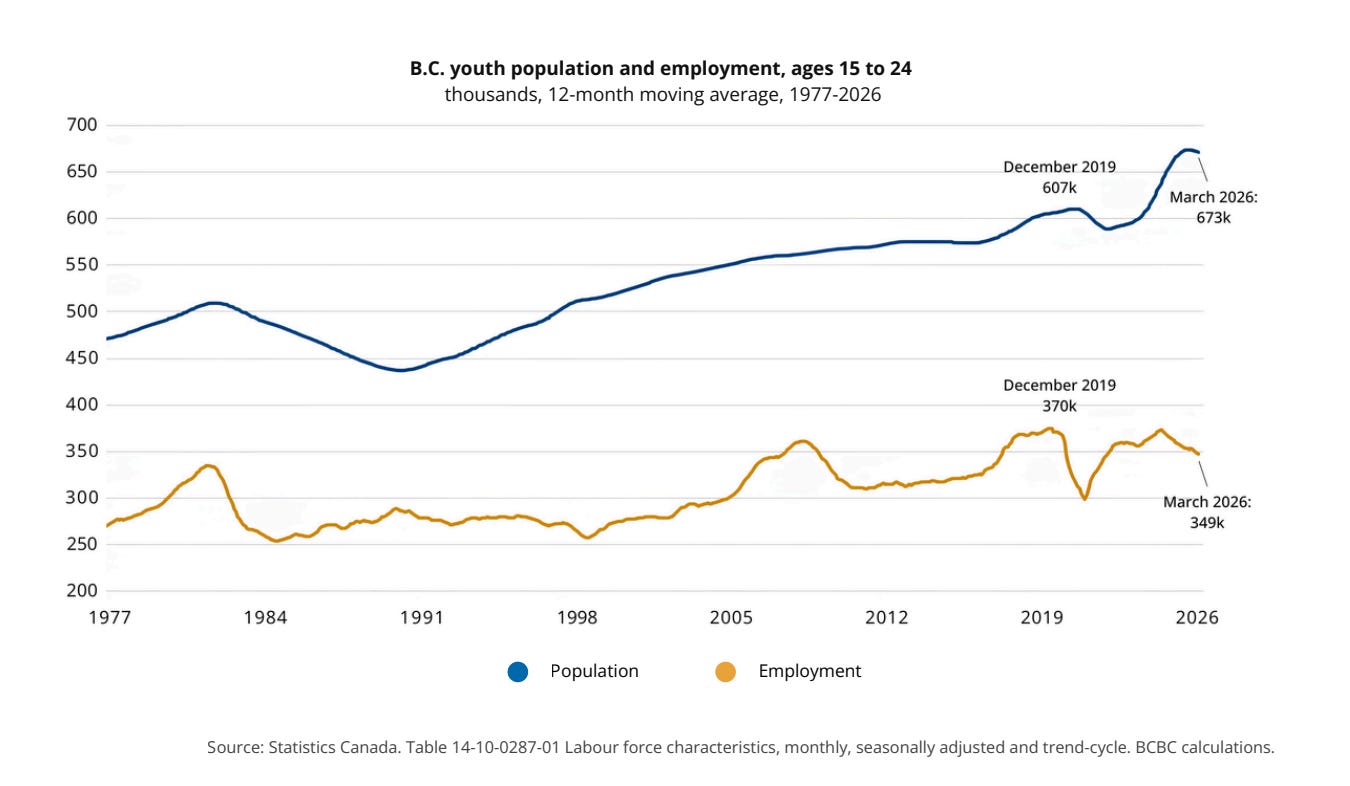
British Columbia's youth labour market has deteriorated more than any other province in Canada, with employment among people aged 15 to 24 falling 14 percent since 2019 even as the province's young population surged, according to a new report from the Business Council of British Columbia (BCBC).
The report paints a picture of a labour market increasingly out of reach for young workers, with fewer young people employed, more unable to find work and a growing number no longer participating in the labour market.
"Youth employment in March 2026 fell back to where it was in mid-2017, erasing roughly eight years of gains," the report said, noting that BC's youth population is now near an all-time high.
The findings place BC at odds with much of the rest of the country. According to the council's analysis of Statistics Canada data, youth employment has grown in every province except BC and Nova Scotia since January 2019. BC recorded the largest decline, while Ontario was essentially unchanged and Nova Scotia posted a slight decline.
The report argues the province's weakening position cannot be understood through unemployment figures alone.
While the youth unemployment rate has climbed to about 14 percent — matching levels last seen during the global financial crisis outside the pandemic period — the council says the figure understates the problem because it does not include young people who have stopped looking for work.
Between January 2019 and March 2026, youth employment in BC fell by roughly 51,000 workers while the number of unemployed youth increased by 23,000. Over the same period, the number of young people classified as not participating in the labour force grew by approximately 85,000.
The council said many of those individuals may be what economists describe as "discouraged workers" — people who have stopped looking for jobs because they do not believe work is available.
That trend has pushed BC's youth labour force participation rate to 58.5 percent, the lowest of any province in Canada and down from 68.7 percent in 2019. At the beginning of that period, BC ranked third nationally.
The report identifies three primary factors behind the decline: weak private-sector hiring, a rapid increase in the supply of entry-level workers, and rising costs for employers.
Private-sector employment in BC has grown by just two percent since 2019, according to the council. Because many young workers begin their careers in private-sector industries such as retail and food services, prolonged weakness in hiring has had an outsized impact on younger job seekers.
The report also points to an increase in the youth population, driven largely by growth in temporary residents and international students. That increase, it argues, expanded the supply of entry-level workers at the same time demand for labour weakened, particularly in retail trade and accommodation and food services.
The decline in BC youth employment was concentrated in retail trade and accommodation and food services, sectors that have traditionally provided first jobs for many young workers.
Between 2019 and 2025, accommodation and food services lost 20,600 youth workers in BC, while retail employment among young people declined by 9,600. Combined, the sectors recorded a 17 percent drop in youth employment, the steepest decline of any province.
The council also argues that rising labour costs are making it more difficult for employers to create entry-level positions. BC's minimum wage stands at $17.85 per hour, the highest in Canada and nearly 30 percent above its 2019 level. The report says the Employer Health Tax, WorkSafeBC premiums and other business costs further increase the cost of hiring inexperienced workers.
Taken together, the report argues, those pressures have left many young British Columbians struggling to gain a foothold in the workforce.
The council warned that prolonged detachment from the labour market can have lasting consequences. Young people who miss opportunities to gain early work experience may face lower lifetime earnings, weaker employment prospects, and greater reliance on government income support later in life.
The findings also raise broader questions about the province's economic outlook. With fewer young people working and contributing taxes, the report argues BC risks a narrower future tax base at a time when it is already dealing with a deteriorating fiscal situation and multiple credit-rating downgrades.
The BCBC said reversing the trend will require policies that encourage private-sector investment and hiring, including easing regulatory burdens in industries that traditionally employ young workers.
The new report comes one week after polling from Research Co. showed only one-third of British Columbians view the province’s economy positively.
How can we support our youth if they can’t even start their careers, we want to add investment into Canada. How can we build a productive society for the future of these youth can’t even start their careers?