

DRIPA backlash grows in BC, business confidence sinks
(Image courtesy Province of BC)
When BC introduced the Declaration on the Rights of Indigenous Peoples Act in 2019, the government presented it as a reconciliation measure that would also bring predictability to the province’s economy. The legislation, the province said at the time, would “create further certainty for investment” and reaffirm BC as a “world-class destination” for business.
Nearly seven years later, that promise is under strain.
A new Business Council of British Columbia (BCBC) survey found 98 percent of respondents do not believe DRIPA is living up to its original promise of creating investment certainty. The same share said they are “very concerned” about DRIPA applying to all laws in the province.
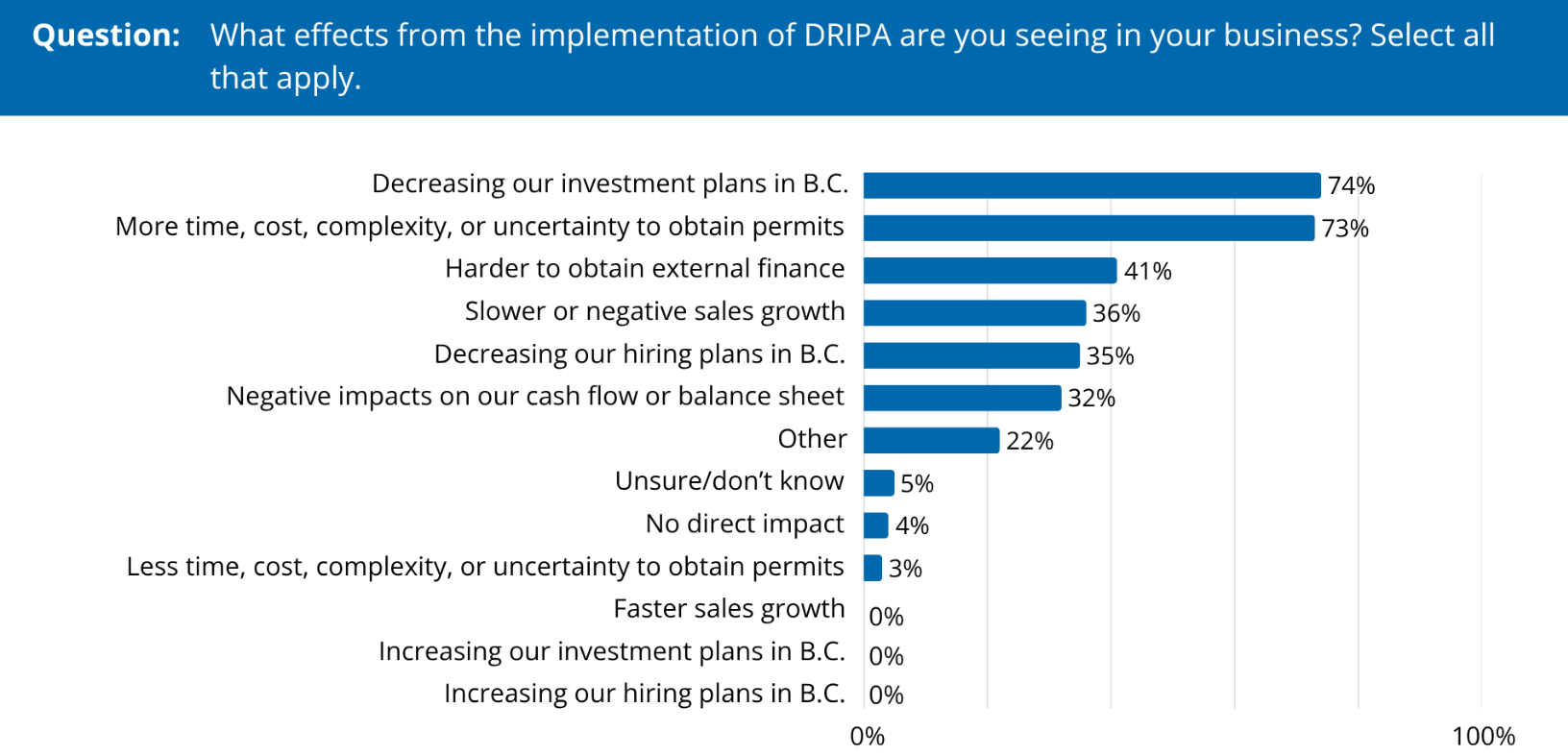
Among respondents, 74 percent said they are decreasing investment plans in BC, 73 percent cited increased time, cost, complexity or uncertainty in permitting, 41 percent reported harder access to external financing, and 35 percent said they are reducing hiring plans.
Only three percent said DRIPA was positively affecting business operations by reducing time, cost, complexity or uncertainty in obtaining permits.
BCBC president and CEO Laura Jones described the survey as a “temperature check” on business sentiment. Her conclusion was blunt: “The desire to work with Indigenous communities to create prosperity for all remains strong but the message from business leaders is clear: DRIPA isn’t working.”
That’s a sharp turn from 2019, when Greg D’Avignon of the BCBC said the organization’s membership was “optimistic for the long-term potential” of BC’s UNDRIP legislation. At the time, the caveat was implementation: business, Indigenous partners and communities needed to be engaged, and government needed to create “clarity and greater certainty.”
Those caveats now sit at the centre of the debate.
(Visual courtesy BCBC)
The government’s original case for DRIPA rested on the idea that reconciliation, transparency and economic certainty could move together. The 2019 release said existing BC laws would not change immediately, that alignment with the UN Declaration on the Rights of Indigenous Peoples would take time, and that consultation with Indigenous peoples and stakeholders including business, industry and local government would be required.
It also said DRIPA would not change consultation rules established by the courts, reopen existing permits or certificates, or affect current regulatory timelines.
That was the framework presented to businesses, Indigenous communities, and the public. Today, much of the debate is about whether that framework has held.
The immediate political crisis intensified after the BC Court of Appeal determined in December 2025 that the government’s obligations under DRIPA are legally enforceable. Premier David Eby argued the ruling created “unlimited legal liability” for the province by opening the door to challenges of provincial laws alleged to be inconsistent with DRIPA.
According to Eby, more than 20 lawsuits involving the province have been launched or amended since the Gitxaala decision was released.
First Nations leaders strongly reject the government’s framing. In an open letter to BC MLAs, the First Nations Leadership Council called Eby’s arguments “not only misleading but … also inherently wrong,” and argued that uncertainty was being created by attempts to undermine DRIPA through unilateral action.
That is the central tension. Business leaders say the current environment is creating uncertainty. First Nations leaders say the government’s attempt to alter or suspend DRIPA is creating uncertainty. The government, meanwhile, has spent months moving from one position to another.
Eby first said changing DRIPA was necessary and non-negotiable. He then proposed suspending parts of the law for up to three years while the province’s appeal of a recent court decision moved toward the Supreme Court of Canada. After backlash from First Nations leaders and a failure to secure full caucus support, he backed away from changes this spring and said the government would work toward a possible solution before the fall legislative session.
“This has been, if I can speak frankly, probably the most challenging issue I’ve worked on in government,” Eby said after abandoning the spring plan. “It is absolutely possible, as a leader, to move off confidently in the wrong direction.”
A government that has repeatedly framed reconciliation as a central commitment is now caught between its own public commitments, legal risk, First Nations opposition, business alarm, and growing public anxiety.
The politics have shifted quickly.
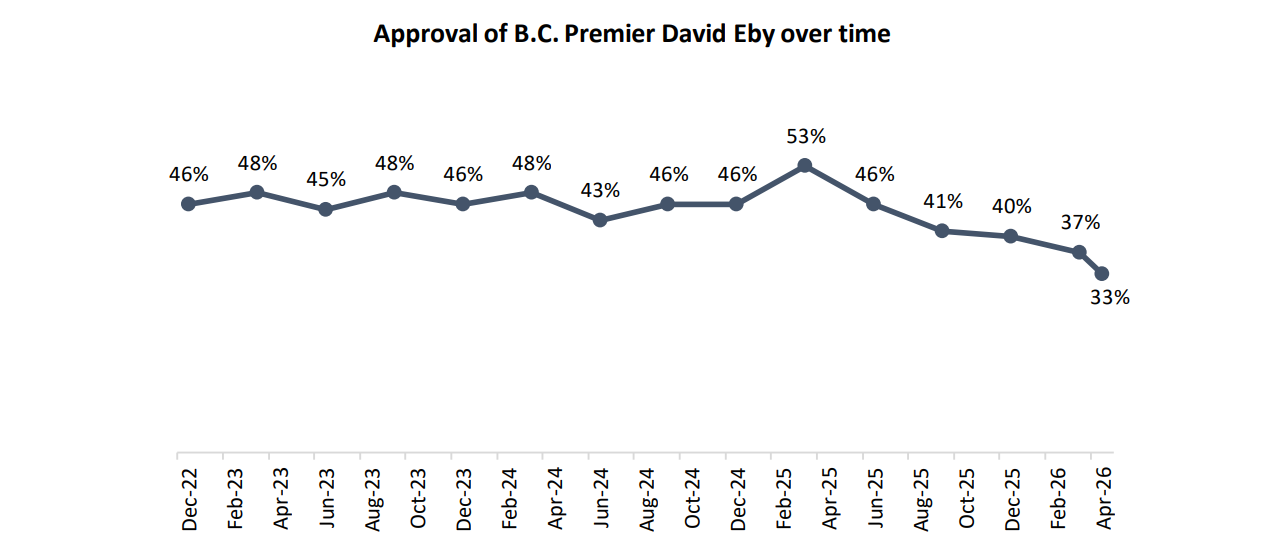
An Angus Reid Institute poll released May 5 found the leaderless BC Conservatives ahead of the BC NDP by 10 points in vote intention, 46 percent to 36 percent. Eby’s approval had fallen to 33 percent, down from 53 percent in March 2025.
The same poll found 47 percent of British Columbians support repealing DRIPA, including 26 percent of those who voted BC NDP in the 2024 provincial election. Fifty-one percent of respondents said BC’s economy would be worse off under DRIPA in the future, while 10 percent said it would be better off.
Public concern also extends to the relationship between Aboriginal title and private property rights. Angus Reid found 55 percent of British Columbians believe Eby has done a “bad job” balancing Aboriginal title with private property rights. More respondents believed DRIPA gives First Nations veto rights on land development in claimed territory than disagreed, although the materials also note that others argue “free, prior and informed consent” refers to robust consultation rather than a full veto.
(Visual courtesy Angus Reid Institute)
The Cowichan decision has added to the broader uncertainty surrounding the debate, even though DRIPA and the Cowichan case are not the same issue. The Cowichan case was launched before DRIPA became law and turned on Section 35 of the Canadian Constitution, not provincial legislation. The Cowichan Tribes have also repeatedly said they do not intend to take away private property.
Still, the political debate has linked DRIPA, Cowichan, Aboriginal title, and property rights into a larger argument over land, legal authority, reconciliation and economic confidence. Questions about what DRIPA does, how it interacts with the courts and what reconciliation means in practice have increasingly become political flashpoints.
That linkage has been used by multiple sides. Conservatives have used DRIPA and Cowichan to attack the BC NDP and, federally, Prime Minister Mark Carney. First Nations leaders have accused the province of misrepresentation and fearmongering. The NDP has tried to defend reconciliation while simultaneously proposing to amend or suspend the law it once championed.
For business, the legal distinctions may matter less than the practical effect. The BCBC survey suggests businesses are already reacting before many of those legal and political questions are fully resolved. The survey also suggests many no longer believe the province has achieved the level of certainty originally promised when DRIPA was introduced.
That does not mean DRIPA alone caused every concern now attached to it. The materials point to court rulings, policy reversals, permitting complexity, title claims, political messaging, and public uncertainty all moving together. But it does mean the province’s original promise of greater certainty is now being judged against a very different political and economic environment.
There are also examples where DRIPA mechanisms appear to have helped projects move forward. Section 7 agreements have been used in relation to projects including Eskay Creek, Red Chris, and Galore Creek. Eby’s proposed suspension would not have affected the sections enabling those agreements.
That nuance matters. The debate is no longer simply whether DRIPA is good or bad, but whether the government can clearly explain how the law functions, how it interacts with the courts, and how reconciliation, economic development, and legal certainty are meant to coexist in practice.
So far, clarity has been difficult to find.
The province now plans to spend the summer working with First Nations leaders toward a possible fall solution. There is no guarantee of agreement. The BC Conservatives support repeal. The BC Greens have criticized the government’s proposed changes. Eby will need his caucus united to pass legislation without opposition support, something he was unable to secure this spring.
In 2019, DRIPA was presented as a framework for reconciliation alongside predictability, transparency, and economic confidence. In 2026, it has become a test of whether the government can manage the legal and political implications of the law it championed while maintaining confidence among businesses, First Nations and the broader public.
