

Privatisation of Canadian airports? What would that look like

In the 2025 Canadian budget, proposed by the Liberal government, there was a section on page 100 of the document. It talked about building up infrastructure and the standard Liberal promise of investing in Canada, particularly when it comes to airports.
However, at the end of the section, in a seemingly throwaway line, the budget mentioned that the government will “also consider options for the privatisation of airports.”
While this idea could open a door the government may be reluctant to enter, Canada has done so in the past. That makes it worth considering: what would such an approach look like in modern times, and how would it function?
Canada’s history with airport privatisation
When airports were constructed in the early 1900s, the government took the lead in building and owning them. This was due to airports being seen as a public good, and there was very little commercial air travel to attract private investment. By the 1980s, led by neoliberal reforms in the Western world by Thatcher and Reagan, and in Canada, Brian Mulroney, the government decided to scale back its involvement in airport management.
This continued in the 1990s under Prime Minister Jean Chrétien, whose government launched the National Airports Policy in July 1994. Under this policy, the 26 major airports that comprise Canada’s National Airports System would be shifted to a commercial operating model. To do this, many airports would become public authorities, but the federal government would still own the airport itself.
The problem with this shift was that it led to less accountability among staff, dysfunction around the finances, and, most crucially, high costs for travellers. If the federal government does not provide money to help build a new terminal, that cost will be passed onto consumers. In the 2000s, this plan eventually became unfeasible due to the high security costs and firewall needs for a society consumed by threats of terrorism.
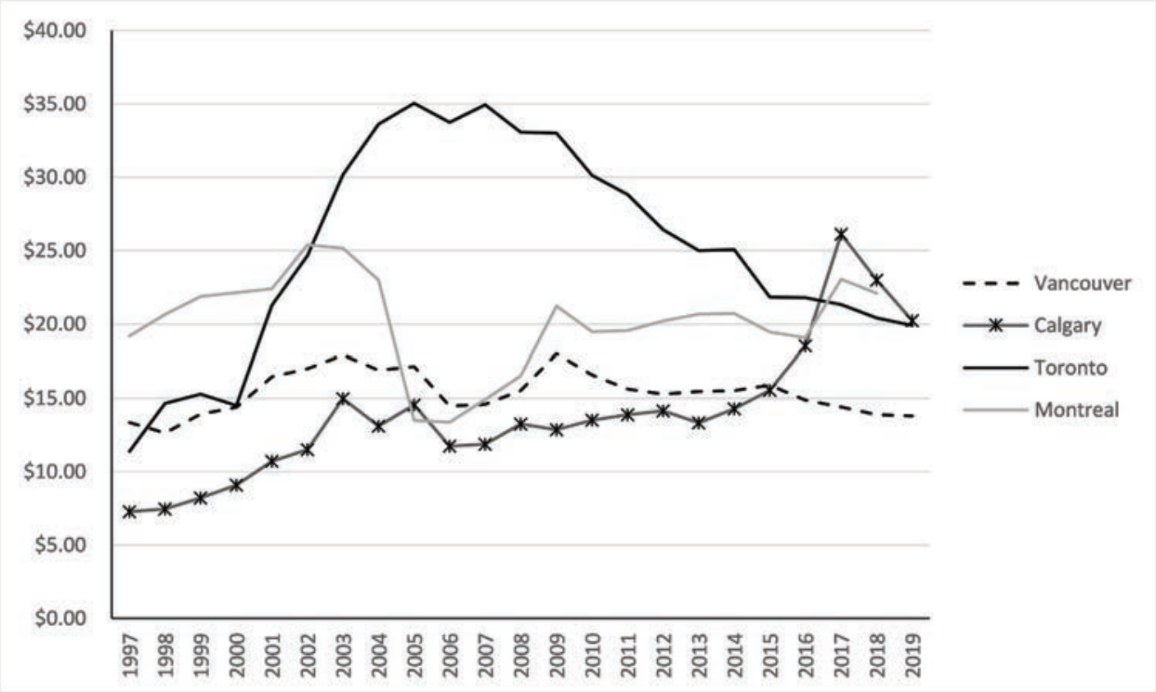
Real Average Total Cost per Passenger from 1997 to 2019. Data retrieved from Statistics Canada and the paper “The Evolution of Canada’s Airports and Airport Policy.”
The modern way airports run mostly involves a private-public partnership arrangement, where airports operate like corporations but receive government funding and oversight.
What the future could be
While it is highly unlikely that the Carney government will sell off Vancouver International, Toronto Pearson, and Montréal–Trudeau to private investors, it is possible that the government could give minority stakes to private entities.
Is it no secret that the Canadian government is fiscally challenged at the moment, expecting to run a $78.3 billion deficit for 2025/2026. It might be prudent to sell off some stakes in these airports to save federal expenditures and reduce bureaucratic oversight, especially if Carney wants his capital expansion projects done quickly and if the acquiring company were, say, a construction company. It would also allow for more access to further private capital through the market.
One famous airport, bigger than any in Canada, is fully privatised: Heathrow Airport in London. Heathrow has been fully private since 1986, owned by the Spanish firm Ferrovial through Heathrow Airport Holdings. Under private control, Heathrow went through significant infrastructure projects to improve its facilities, and operating profits grew.
However, Heathrow is located in London, one of the busiest and most important cities in the world. Travel to there is likely inelastic, and the condition of Heathrow will likely not deter tourists or businesspeople from visiting London. Private investors may encourage airport management to cut corners in loss-generating areas, even though they are important, such as security, accessibility, and safety operations. Airports are not designed purely for business and leisure, but are essential parts of the modern economy to facilitate the transfer of goods. Threatening to tinker with it could have massive drawbacks for the future, both seen and unseen.
Ultimately, there appears to be no public appetite for privatising airports. Canadians appear satisfied with the current model, and Vancouver, Toronto, and Montréal consistently rank among the world’s top airports, well ahead of many in the United States. Nevertheless, it is something to think about given that line in the 2025 budget, leaving the door open.